
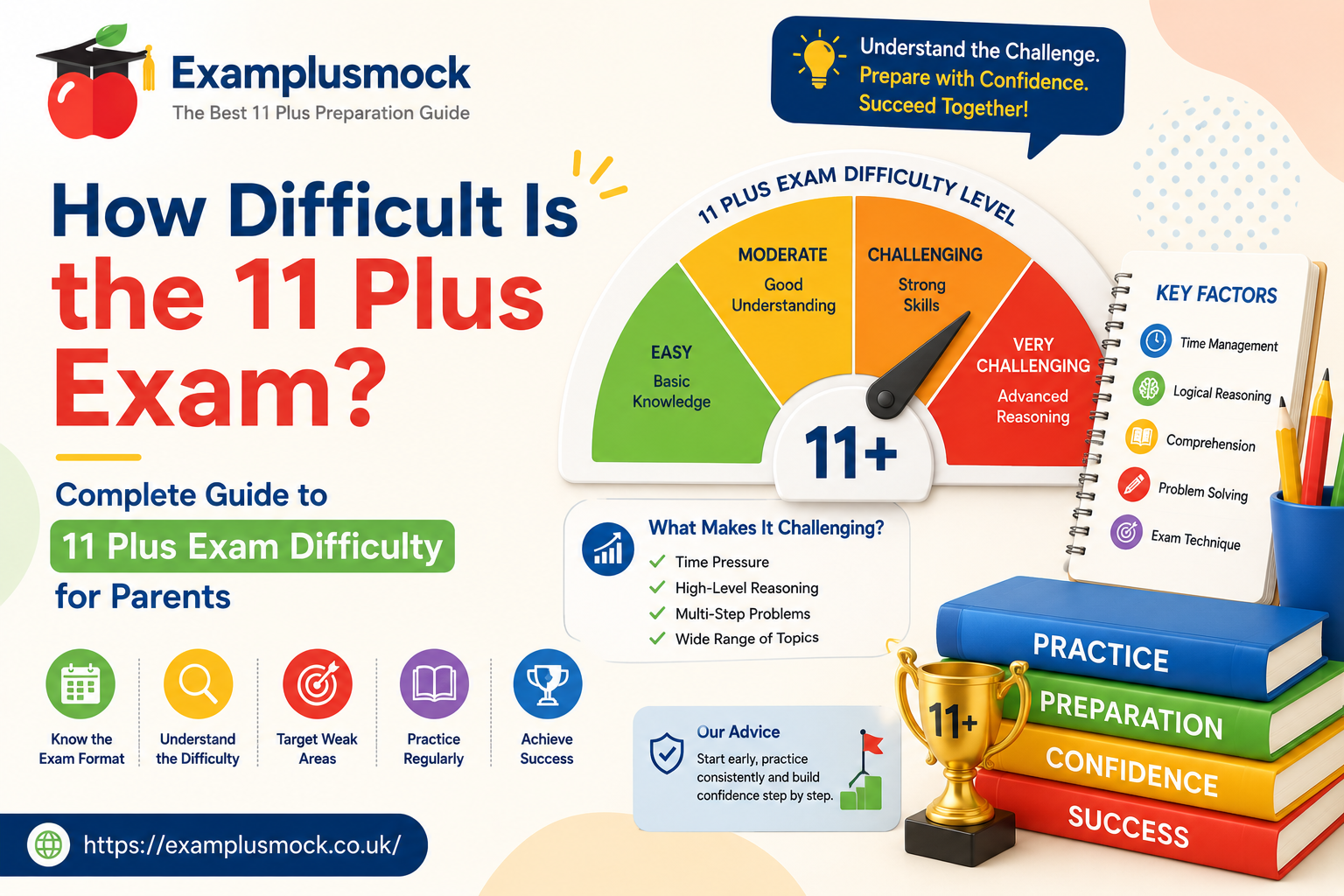
How Difficult Is the 11 Plus Exam?
Many parents researching grammar school admissions ask the same important question: How difficult is the 11 Plus Exam? Understanding 11 Plus Exam Difficulty is essential because it helps families create realistic expectations and effective preparation plans. The exam is designed to identify children with strong academic potential, but its level of difficulty can vary depending on the child’s skills, confidence, preparation, and familiarity with exam-style questions.
Some children find the exam manageable because they already have strong reading habits, a broad vocabulary, and good mathematical skills. Others may initially struggle because the exam includes question types that are not always covered extensively in primary school lessons. Reasoning questions, for example, often require children to think differently and apply logic rather than simply recall information.
Although many parents worry about 11 Plus Exam Difficulty, the reality is that preparation plays a major role in success. Children who prepare consistently, practise regularly, and build confidence through mock exams often perform far better than those who rely solely on natural ability.
Understanding What Makes the Exam Challenging
The exam is not designed to trick children, but it is intended to distinguish between candidates applying for competitive grammar school places. Several factors contribute to 11 Plus Exam Difficulty.
• Strict time limits
• Advanced vocabulary
• Complex reasoning questions
• Competitive admissions
• Multiple subject areas
• Pressure associated with school selection
Many children discover that knowing the answer is not enough. They must also answer accurately and efficiently within limited time constraints.
Is the 11 Plus Exam Harder Than School Tests?
Most children notice significant differences between regular classroom assessments and grammar school entrance exams. School tests usually focus on recently taught topics. In contrast, the 11+ exam assesses broader academic skills and potential.
Important Differences
• Greater emphasis on reasoning
• More challenging vocabulary
• Faster pace
• Higher expectations
• Strong focus on problem-solving
• Greater competition
These differences contribute to overall 11 Plus Exam Difficulty and explain why targeted preparation is often beneficial.
The Role of Competition
Competition is one of the most overlooked aspects of 11 Plus Exam Difficulty. Grammar schools often receive far more applications than available places. This means children are not only attempting to achieve a pass mark but are also competing against many other well-prepared candidates.
Factors influencing competition include:
• Number of applicants
• Number of available places
• School popularity
• Local demand
• Regional admissions policies
A score that secures a place one year may not be sufficient the next if competition levels change.
Which Subjects Are Included?
The exact format varies by school and region, but most exams assess four major areas.
English
English sections often include:
• Reading comprehension
• Grammar
• Vocabulary
• Inference questions
• Language analysis
Many children find vocabulary-related questions particularly challenging because they depend on long-term language development.
Mathematics
Maths questions may assess:
• Arithmetic
• Fractions
• Percentages
• Ratios
• Problem-solving
• Multi-step calculations
Some questions require children to apply several skills simultaneously.
Verbal Reasoning
Verbal reasoning contributes significantly to 11 Plus Exam Difficulty.
Question types may include:
• Synonyms
• Antonyms
• Word relationships
• Letter sequences
• Logical deductions
Strong vocabulary and reasoning skills are essential for success.
Non-Verbal Reasoning
Non-verbal reasoning often feels unfamiliar because it receives less emphasis in many primary schools.
Children may encounter the following:
• Shape patterns
• Rotations
• Reflections
• Sequences
• Spatial reasoning
Regular practice helps children become more comfortable with these question types.
Why Vocabulary Has a Major Impact
Vocabulary is one of the strongest predictors of success.
Children with broad vocabularies often:
• Understand questions more quickly
• Perform better in comprehension
• Succeed in verbal reasoning
• Read more confidently
• Make fewer mistakes
Parents can support vocabulary development through daily reading, discussion, and word-learning activities.
Reading Habits and Exam Success
Strong readers frequently find many sections of the exam easier.
Benefits of Reading
• Better comprehension
• Improved vocabulary
• Enhanced concentration
• Greater general knowledge
• Stronger analytical thinking
Reading fiction and non-fiction regularly helps children prepare naturally for several aspects of the examination.
How Time Pressure Affects Performance
One of the most significant contributors to 11 Plus Exam Difficulty is timing.
Many children know the correct answers but struggle to complete all questions within the allocated time.
Common timing issues include:
• Spending too long on difficult questions
• Reading too slowly
• Rushing easy questions
• Panicking near the end
• Leaving sections incomplete
Time management strategies can greatly improve performance.
How Mock Exams Reduce Difficulty
Mock exams are among the most effective preparation tools available.
Parents can explore: https://examplusmock.co.uk/
Dedicated mock exam preparation: https://examplusmock.co.uk/11-plus-mock-tests/
Additional support: https://examplusmock.co.uk/contact-us/
Benefits of Mock Exams
• Familiarity with exam conditions
• Improved confidence
• Better pacing
• Reduced anxiety
• Stronger time management
• Realistic performance feedback
Mock exams help children experience realistic pressure before the actual assessment.
The Importance of Starting Preparation Early
Children who begin preparing early often find the process less stressful.
Benefits of Early Preparation
• More time to build skills
• Reduced pressure
• Better confidence
• Stronger understanding
• More revision opportunities
Many families begin introducing preparation during Year 4 and move into structured revision during Year 5.
Common Challenges Children Face
Many students encounter similar difficulties.
Typical Challenges
• Limited vocabulary
• Weak reasoning skills
• Poor time management
• Lack of confidence
• Exam anxiety
• Difficulty concentrating
Recognizing these challenges early allows parents to provide effective support.
How Parents Can Help
Parents play an important role throughout preparation.
Helpful actions include:
• Creating a study routine
• Encouraging reading
• Supporting vocabulary development
• Monitoring progress
• Celebrating improvements
• Maintaining realistic expectations
Children usually perform best when they feel supported rather than pressured.
Effective Revision Strategies
Good preparation is about quality rather than quantity.
Useful Revision Methods
• Practice papers
• Vocabulary notebooks
• Flashcards
• Timed exercises
• Mock exams
• Regular review sessions
These strategies help reduce perceived 11 Plus Exam Difficulty by increasing familiarity and confidence.
Mistakes That Make the Exam Feel Harder
Some preparation habits can unintentionally increase stress.
Avoid:
• Starting too late
• Ignoring weak areas
• Comparing children with others
• Overloading study schedules
• Focusing only on scores
• Skipping mock exams
Balanced preparation produces better long-term outcomes.
Building Confidence Before Exam Day
Confidence often influences performance as much as academic ability.
Children build confidence through:
• Consistent revision
• Positive feedback
• Practice under timed conditions
• Realistic mock exams
• Gradual improvement
When children feel prepared, they are more likely to approach the exam calmly and perform to their full potential.
Additional Learning Resources
Parents can support preparation using:
https://examplusmock.co.uk/11-plus-mock-tests/
https://examplusmock.co.uk/contact-us/
https://www.bbc.co.uk/bitesize
These resources can help strengthen skills and improve readiness.
How 11 Plus Exam Difficulty Varies Between Schools
One important factor that affects 11 Plus Exam Difficulty is the school or exam provider. Not all grammar schools use identical tests. Some schools use GL Assessment papers, while others use CEM-style exams or their own entrance assessments.
Differences may include:
• Question formats
• Subject weighting
• Vocabulary difficulty
• Time limits
• Scoring methods
Because of these variations, parents should research the specific schools their child plans to apply for. Understanding the assessment format helps families prepare more effectively and manage 11 Plus Exam Difficulty with greater confidence.
The Impact of Exam Anxiety on Performance
Sometimes 11 Plus Exam Difficulty is influenced more by anxiety than by academic ability. A child who performs well during practice sessions may struggle under pressure if they feel nervous on exam day.
Common signs of exam anxiety include:
• Difficulty concentrating
• Racing thoughts
• Loss of confidence
• Forgetting familiar information
• Poor time management
Parents can reduce anxiety by encouraging regular mock exams, maintaining realistic expectations, and focusing on progress rather than perfection. Children who learn to manage nerves often find that 11 Plus Exam Difficulty becomes much more manageable.
Developing Problem-Solving Skills for Success
A major feature of 11 Plus Exam Difficulty is that many questions require children to apply knowledge rather than simply recall facts.
Problem-solving skills help children:
• Analyse questions quickly
• Recognise patterns
• Eliminate incorrect answers
• Work efficiently
• Improve accuracy
Activities such as puzzles, logic games, reasoning exercises, and challenging Maths questions can strengthen these skills over time. Strong problem-solving ability often provides a significant advantage during grammar school entrance exams.
How Consistency Beats Intensive Revision
Many parents assume that long study sessions are necessary to overcome 11 Plus Exam Difficulty. In reality, consistent study habits usually produce better outcomes.
Benefits of regular revision include:
• Better retention
• Reduced stress
• Improved confidence
• Stronger understanding
• Sustainable progress
Even 30 to 45 minutes of focused study several times each week can lead to substantial improvement over time. Consistency helps children develop habits that support success not only in the 11+ exam but throughout their education.
What Happens After the 11 Plus Exam?
Parents often focus entirely on preparation and overlook what happens after the exam.
Following the assessment:
• Results are released
• Scores are standardised
• School applications are reviewed
• Admissions decisions are made
• Offers are communicated to families
Understanding the process helps reduce uncertainty and allows parents to support their child regardless of the outcome. Even if a child does not secure a grammar school place, the skills developed while overcoming 11 Plus Exam Difficulty often benefit future academic success.
Why Mock Exams Are Essential for Managing 11 Plus Exam Difficulty
Mock exams remain one of the most effective methods for reducing 11 Plus Exam Difficulty because they simulate the real testing environment.
Children learn how to:
• Follow exam instructions
• Manage timing effectively
• Remain calm under pressure
• Maintain concentration
• Build confidence
Parents can access realistic mock testing through:
Mock test information:
https://examplusmock.co.uk/11-plus-mock-tests/
Contact and support:
https://examplusmock.co.uk/contact-us/
The more familiar children become with exam conditions, the less intimidating the actual examination feels.
Frequently Asked Questions
Is the 11 Plus Exam very difficult?
The level of difficulty varies depending on the child and their preparation. Many students find reasoning and vocabulary questions challenging at first, but regular practice and structured revision often make the exam significantly more manageable. Consistent preparation remains one of the most effective ways to improve performance.
What is the hardest part of the exam?
There is no single hardest section because every child has different strengths and weaknesses. Some students struggle with verbal reasoning and vocabulary, while others find non-verbal reasoning more difficult. Time management is another challenge that affects many candidates.
Can average students pass the 11 Plus Exam?
Yes. Many successful candidates are not naturally gifted in every subject. Strong preparation, consistent practice, effective revision techniques, and good exam habits often play a larger role than raw ability alone.
How important are mock exams?
Mock exams are extremely valuable because they provide realistic exam experience. They help children improve confidence, timing, concentration, and exam technique while identifying areas that need further improvement before the real assessment.
Does starting early make a difference?
Yes. Starting preparation early allows children to build skills gradually and avoid unnecessary pressure. Early preparation creates opportunities for consistent improvement and stronger confidence.
Conclusion
Understanding 11 Plus Exam Difficulty helps families approach grammar school preparation with realistic expectations and effective strategies. While the exam can be challenging because of advanced vocabulary, reasoning questions, competition, and time pressure, these obstacles can be overcome through structured preparation, regular reading, mock exams, and consistent revision. Children who build confidence gradually and practise regularly often discover that the exam becomes far more manageable. With the right support and preparation plan, families can significantly reduce 11 Plus Exam Difficulty and help children achieve their full potential.