
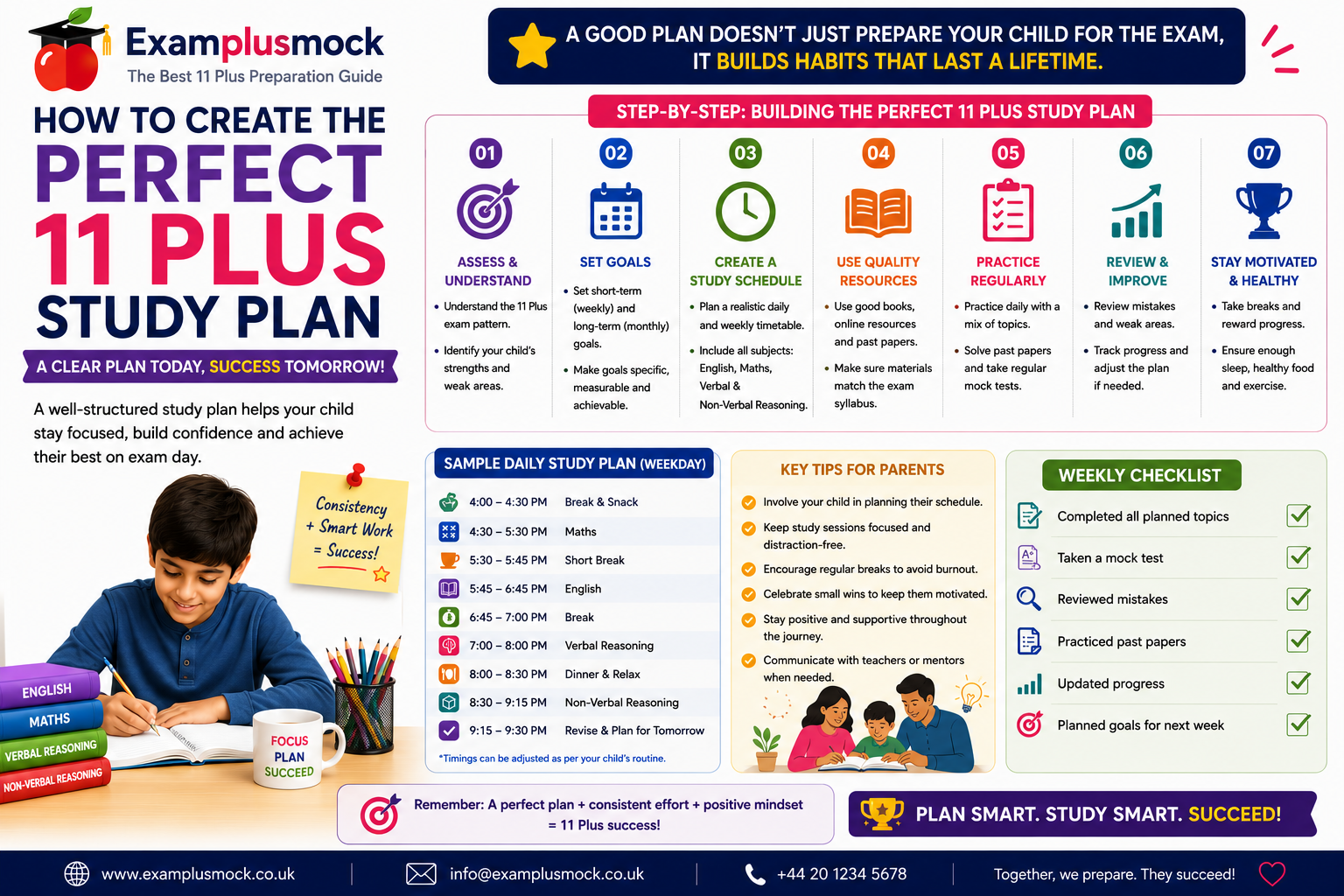
How to Create the Perfect 11 Plus Study Plan
Preparing for the 11+ can feel challenging for both children and parents. There are different subjects to practice, new question types to understand, timed exercises to complete, and plenty of schoolwork to manage at the same time. Without a clear routine, preparation can quickly become stressful or inconsistent. A well-designed 11 Plus Study Plan can make preparation more manageable. Instead of expecting your child to study for long hours every day, a structured plan focuses on regular practice, targeted improvement, revision, and enough time for rest.
The best study plan should also reflect your child’s individual needs. Some children may need more support with maths, while others may need additional practice with verbal reasoning, English comprehension, or non-verbal reasoning. The aim is not simply to complete as many questions as possible but to help your child become more confident, accurate, and comfortable with the types of questions they may face.
According to GL Assessment’s 11+ guidance, 11+ tests can vary between schools and local authorities, with subjects potentially including English, math, verbal reasoning, and non-verbal reasoning. This makes it important to check the specific requirements of the school or admissions authority before creating your child’s study program.
Why an 11 Plus Study Plan Matters
An 11 Plus Study Plan gives your child a clear structure for preparation. Rather than deciding what to study every day, you can plan specific activities in advance.
A structured routine can help your child:
-
Build consistent study habits
-
Identify weaker subjects
-
Improve speed and accuracy
-
Develop exam technique
-
Practise different question types
-
Track progress over time
-
Become familiar with timed exercises
-
Reduce last-minute revision
-
Balance preparation with schoolwork and leisure
A plan can also make it easier for parents to understand whether preparation is working. Regular practice scores and review sessions can show which areas are improving and which need more attention. The objective should be steady progress rather than perfection.
Start by Understanding the 11 Plus Test
Before creating your timetable, find out what your child’s target school or admissions authority actually tests. An 11 Plus Study Plan should reflect the specific subjects and skills your child needs to prepare for. Different 11+ tests can use different combinations of subjects. GL Assessment explains that 11+ tests may include English, maths, verbal reasoning and non-verbal reasoning, while the exact format can vary by school or local authority.
Check the Required Subjects
Find out whether your child’s test includes:
-
English
-
Maths
-
Verbal reasoning
-
Non-verbal reasoning
-
Numerical reasoning
-
Writing or comprehension
-
Any school-specific assessment components
Do not assume that every grammar school uses exactly the same test.
Check the Test Format
Parents should also check whether the assessment is paper-based or digital, how many sections are included, whether the test is timed, and what type of answer sheet children use. Understanding the format early allows you to make your 11 Plus Study Plan more relevant.
Assess Your Child’s Current Level
Before starting intensive preparation, establish your child’s current strengths and weaknesses. An 11 Plus Study Plan should begin with a clear understanding of which areas need more attention. You do not need to make this a stressful formal examination. A combination of practice questions, short exercises, and an age-appropriate mock test can provide useful information.
Look at Accuracy and Speed
Do not focus only on the final score.
Record:
-
Number of questions attempted
-
Number answered correctly
-
Number answered incorrectly
-
Questions left unanswered
-
Time taken
-
Topics causing difficulty
-
Mistakes caused by misunderstanding
-
Mistakes caused by rushing
For example, a child may achieve a good score in maths but take too long to complete the questions. Another child may work quickly but lose marks through careless errors. These situations require different study strategies.
Create a Strengths and Weaknesses List
After the initial assessment, divide topics into three groups:
Strong: Topics your child understands and can answer accurately.
Developing: Topics your child understands but needs more practice with.
Needs Support: Topics where your child regularly struggles or does not yet understand the underlying concept.
This simple system can help you decide where study time should be spent.
Set Realistic Study Goals
Your 11 Plus Study Plan should have clear goals rather than simply stating “study maths” or “do English practice”.
A stronger goal might be:
-
Complete 15 fraction questions with at least 80% accuracy.
-
Practice 20 verbal reasoning questions within a set time.
-
Read a short passage and answer comprehension questions accurately.
-
Complete one non-verbal reasoning question type and review mistakes.
-
Improve multiplication recall through short daily practice.
Specific goals make progress easier to measure.
Use Short-Term and Long-Term Goals
Long-term goals in an 11 Plus Study Plan might include becoming confident across all required subjects before the examination. Short-term goals should be achievable within a week and help your child make steady progress.
For example:
Long-term goal: Improve maths accuracy.
Weekly goal: Practice fractions, percentages, and ratios.
Daily goal: Complete 10–15 questions and review mistakes.
This approach makes a large goal feel more manageable.
Decide How Many Days to Study
There is no single number of days that works for every child. An 11 Plus Study Plan with a consistent routine spread across the week can often be more manageable than occasional intensive sessions. For many children, preparation can include several focused study sessions during the week, with a mixture of academic practice, reading, revision, and mock-test work.
The exact routine should take into account:
-
Child’s age
-
Current ability
-
School workload
-
Exam date
-
Other activities
-
Concentration levels
-
Subjects requiring additional support
The important point is consistency.
Avoid Overloading the Timetable
A study plan that fills every evening with revision may become difficult to maintain.
Children need time for:
-
Sleep
-
Play
-
Exercise
-
Family activities
-
Hobbies
-
Friends
-
Schoolwork
-
Relaxation
A sustainable plan is usually more useful than an overly demanding timetable.
Build a Weekly 11 Plus Study Plan for Consistent Progress
An 11 Plus Study Plan can make preparation much easier to manage through a weekly timetable. Instead of repeating the same subject every day, rotate activities throughout the week.
Example Weekly Study Schedule
Monday – Maths
Focus on one or two specific math topics. Finish with a short review of mistakes.
Tuesday – English
Practice comprehension, vocabulary, spelling, grammar, or sentence-based questions.
Wednesday – Verbal Reasoning
Work on vocabulary, word relationships, codes, sequences, or other relevant question types.
Thursday – Maths and Reading
Complete a short maths activity followed by independent reading.
Friday – Non-Verbal Reasoning
Practise shapes, patterns, sequences, transformations, or other relevant questions.
Saturday – Mock Test or Mixed Practice
Use a timed practice paper or mixed-subject exercise depending on the child’s stage of preparation.
Sunday – Review and Rest
Review difficult questions briefly and allow plenty of time for rest.
This is only an example. Your child’s actual schedule should be adapted to their needs and the test format.
Use Different Study Activities
An effective 11 Plus Study Plan should not consist entirely of worksheets. Mixing activities can help maintain concentration and make preparation less repetitive.
Include Skill Practice
Skill practice can focus on individual areas such as:
-
Fractions
-
Decimals
-
Percentages
-
Word problems
-
Vocabulary
-
Spelling
-
Grammar
-
Reading comprehension
-
Verbal reasoning
-
Non-verbal reasoning
Practicing individual skills is particularly useful when a child has identified weaknesses.
Include Mixed Practice
Once your child becomes more comfortable with individual topics, introduce mixed questions as part of an 11 Plus Study Plan. Mixed practice encourages children to identify what type of problem they are facing before deciding which method to use. This can help prepare them for the unpredictability of an examination.
Include Reading in the Study Plan
Reading is a valuable part of an 11 Plus Study Plan, particularly when English and comprehension skills are involved. Encourage your child to read a variety of age-appropriate material.
This could include:
-
Fiction
-
Non-fiction
-
Newspapers or children’s news
-
Biographies
-
History books
-
Science books
-
Magazines
-
Quality online educational content
Discuss What Your Child Reads
Reading should not always be treated as another test.
Ask your child questions such as:
-
What happened in the chapter?
-
Why did the character behave that way?
-
What do you think will happen next?
-
What does this word mean?
-
Can you explain the main idea?
These conversations can encourage comprehension and vocabulary development without making every reading session feel like revision.
Add Vocabulary Practice
Vocabulary can be developed gradually rather than through large lists of words. An 11 Plus Study Plan can include regular opportunities to learn new vocabulary. When your child encounters an unfamiliar word, discuss its meaning and context.
Build a Word Bank
Keep a simple vocabulary notebook or digital list containing:
-
New word
-
Meaning
-
Synonym
-
Antonym
-
Example sentence
Review a small number of words regularly. Short, repeated exposure can be more manageable than attempting to memorize a large vocabulary list in one sitting.
Develop Maths Skills Gradually
Maths should be a regular part of your 11 Plus Study Plan when it forms part of the required assessment.
Start by identifying areas where your child needs improvement.
Potential areas can include:
-
Mental arithmetic
-
Fractions
-
Decimals
-
Percentages
-
Ratio
-
Measurement
-
Geometry
-
Data interpretation
-
Word problems
-
Money
-
Time
-
Number sequences
Focus on Understanding Before Speed
Speed is important in a timed test, but children should first understand the method. An 11 Plus Study Plan should focus on accuracy and understanding before increasing speed. If a child repeatedly makes the same mistake, simply completing more questions may not solve the problem. Stop, identify the misunderstanding, explain the method, and then try a smaller set of similar questions.
Practise Verbal Reasoning
Verbal reasoning can involve different types of word-based problems.
Depending on the test, practice may include the following:
-
Word relationships
-
Synonyms
-
Antonyms
-
Letter sequences
-
Codes
-
Missing words
-
Odd-one-out questions
-
Word patterns
Focus on Question Types
When introducing a new question type, make sure your child understands the instructions before timing them. An 11 Plus Study Plan should allow children to build confidence before introducing timed practice. Once the method becomes familiar, gradually introduce time limits. This helps develop both accuracy and efficiency.
Practice Non-Verbal Reasoning
Non-verbal reasoning involves visual problem-solving and can include shapes, patterns, sequences, and transformations. An 11 Plus Study Plan should include regular non-verbal reasoning practice so children can develop confidence in identifying relationships between images rather than simply recalling facts.
Teach the Process
Encourage your child to look for:
-
Rotation
-
Reflection
-
Number of shapes
-
Position changes
-
Size changes
-
Direction
-
Shading
-
Repeated patterns
The aim is to develop a systematic way of examining each question.
Introduce Timed Practice Gradually
Timed practice is an important part of preparation, but it does not need to begin immediately. Start with untimed practice so your child can understand the question format. Then introduce short time limits. Gradually increase the number of questions and the level of time pressure. GL Assessment’s parent guidance recommends becoming familiar with the test style and using practice papers under timed conditions to help children develop time-management strategies.
Teach Time Management
Children should learn to:
-
Read instructions carefully
-
Avoid spending too long on one question
-
Move on when appropriate
-
Return to difficult questions when possible
-
Keep track of time
-
Check answers when time allows
Time management should become a normal part of practice rather than something introduced immediately before the exam.
Use Mock Tests Strategically
Mock tests can help you understand how your child performs under realistic conditions. An 11 Plus Study Plan can include mock tests at appropriate stages of preparation. However, avoid giving full mock tests every day, as regular practice and targeted revision are also important.
A mock test can help identify:
-
Subject weaknesses
-
Timing issues
-
Careless mistakes
-
Concentration problems
-
Question types that cause difficulty
-
Areas of improvement
You can find additional resources through the 11+ Mock Tests section on ExamPlusMock.
Always Review Mock Test Results
The most valuable part of a mock test may be what happens afterwards. Do not simply record the score and move on.
Ask:
-
Which questions were wrong?
-
Why were they wrong?
-
Was the concept misunderstood?
-
Was the question misread?
-
Was the child rushing?
-
Did the child run out of time?
-
Could the question be solved using a different method?
Use these findings to update the next week’s study plan.
Keep a Mistake Book
A mistake book is a simple but effective revision tool. An 11 Plus Study Plan can include regular review of this book to help children identify patterns in their mistakes. Whenever your child makes a repeated or important mistake, record the question type and the reason for the error.
Organise Mistakes by Topic
For example:
Maths: Percentage calculation error
English: Inference question misunderstood
Verbal Reasoning: Vocabulary confusion
Non-Verbal Reasoning: Pattern relationship missed
Review the mistake book regularly.
The aim is not to remind your child about failures. Instead, it helps them recognize patterns and learn from mistakes.
Track Progress Weekly
Your 11 Plus Study Plan should include a simple progress-tracking system.
You could record:
| Week | Subject | Topic | Accuracy | Main Issue |
|---|---|---|---|---|
| 1 | Maths | Fractions | 65% | Method |
| 2 | Maths | Fractions | 76% | Careless errors |
| 3 | Maths | Fractions | 84% | Timing |
| 4 | Maths | Fractions | 90% | Improving |
You do not need to track every question. The purpose is to identify trends. If accuracy improves consistently, move on to another area. If a topic remains weak, consider additional explanation or targeted practice.
Adjust the Study Plan Regularly
An 11 Plus Study Plan should not remain unchanged for months. Your child’s needs will change as preparation progresses. At the beginning, more time may be needed for learning concepts.
Later, the focus can shift towards the following:
-
Mixed practice
-
Timed questions
-
Mock tests
-
Exam technique
-
Accuracy
-
Time management
-
Confidence
Review the Plan Every Two or Three Weeks
Ask:
-
What has improved?
-
What is still difficult?
-
Is the workload manageable?
-
Is my child becoming more confident?
-
Are school commitments affecting preparation?
-
Are practice scores improving?
-
Does the plan need more rest time?
Make changes based on evidence rather than assumptions.
Make the Plan Child-Friendly
An 11 Plus Study Plan should involve your child where possible. Explain why they are practising a particular topic. Allow them to understand the weekly goal and celebrate improvements.
Use Small Rewards
Rewards do not need to be expensive.
You could use:
-
Choosing a family film
-
Extra reading time
-
Choosing a weekend activity
-
A favourite snack
-
Time for a hobby
The focus should remain on effort and progress rather than only achieving a particular score.
Avoid Common Study Plan Mistakes
Even a well-intentioned timetable can become ineffective if it is too demanding or repetitive.
Do Not Study for Excessively Long Sessions
Long sessions can reduce concentration and motivation. Use focused periods followed by appropriate breaks.
Do Not Focus Only on Weak Subjects
Weak areas need attention, but children should also maintain their strengths. A balanced timetable can include both improvement work and confidence-building activities.
Do Not Use Mock Tests Every Day
Mock tests are useful for measuring progress, but excessive testing can increase pressure and reduce the time available for learning. Use them strategically.
Do Not Ignore Mistakes
Completing hundreds of questions without reviewing errors may not lead to meaningful improvement. Always allow time for correction and reflection.
Do Not Compare Children
Every child develops at a different pace. Compare your child’s current performance with their previous performance rather than using another child’s results as the benchmark.
Balance 11 Plus Preparation With Schoolwork
Children already have regular school responsibilities. Your 11 Plus Study Plan should complement school rather than compete with it. If your child has a demanding school week, reduce the amount of additional practice. During school holidays, you may have more flexibility to introduce longer sessions or additional mock tests. The plan should be flexible enough to change when circumstances change.
Keep Exam Preparation Positive
Confidence can influence how children approach difficult questions. An 11 Plus Study Plan should support confidence by helping children recognise that mistakes are part of learning. A child who expects to fail may give up quickly, while a child who understands that mistakes are part of learning may be more willing to try again.
Use encouraging language.
Instead of saying:
“You got this wrong again.”
Try:
“Let’s see what caused this mistake and work out a better method.”
This creates a more positive learning environment.
The Final Weeks of the 11 Plus Study Plan
As the exam approaches, the emphasis in an 11 Plus Study Plan should gradually shift. Avoid trying to introduce large amounts of new material at the last minute.
Focus on Consolidation
Use the final stage to:
-
Review key topics
-
Practise common question types
-
Complete selected timed exercises
-
Review the mistake book
-
Complete suitable mock tests
-
Practise time management
-
Build confidence
Your child should ideally enter the exam feeling familiar with the process.
Prioritise Rest Before the Exam
The final days are not the time for excessive cramming. An 11 Plus Study Plan should focus on maintaining a normal routine, allowing enough sleep, preparing everything needed for the exam, and keeping the atmosphere calm. A child who is exhausted may struggle to concentrate even if they have completed lots of revision.
When to Consider Additional Support
Some children make excellent progress independently, while others benefit from extra support. An 11 Plus Study Plan can be adapted to provide additional guidance where needed.
Additional help may be useful if your child:
-
Repeatedly struggles with a particular topic
-
Has difficulty understanding instructions
-
Needs help developing exam technique
-
Becomes anxious during timed practice
-
Cannot maintain a consistent routine
-
Needs more personalised feedback
Parents looking for information about available resources or wanting to discuss preparation can visit the ExamPlusMock Contact Us page.
Use Online 11 Plus Resources Carefully
Online resources can provide useful practice, but quality matters. Choose resources that match the relevant test format and your child’s current level. The ExamPlusMock website provides 11+ preparation resources that can be incorporated into a structured study routine.
Choose Quality Over Quantity
Your child does not need hundreds of random worksheets. An 11 Plus Study Plan can use a smaller collection of suitable practice activities, combined with careful review, which can be more useful than completing large amounts of unrelated material.
Example 12-Week 11 Plus Study Plan
For parents who want a longer-term framework, the following structure can be adapted to suit the child’s needs.
Weeks 1–2: Baseline and Familiarisation
Identify strengths and weaknesses. Introduce the relevant question types without excessive time pressure.
Weeks 3–4: Core Skills
Focus on essential math, English, verbal reasoning, and non-verbal reasoning skills required by the target test.
Weeks 5–6: Targeted Practice
Spend more time on weak areas while maintaining regular practice of stronger subjects.
Weeks 7–8: Mixed Questions
Introduce more mixed-topic exercises so your child learns to switch between different question types.
Weeks 9–10: Timed Practice
Increase timed exercises and introduce suitable mock tests. Review every mistake carefully.
Weeks 11–12: Exam Preparation
Focus on consolidation, time management, confidence, and familiarization with the test process. Adjust this schedule according to the actual exam date and your child’s progress.
A Simple Daily 11 Plus Study Plan Routine
An 11 Plus Study Plan does not need to include a complicated daily routine.
For example:
5 minutes: Quick mental math or vocabulary review.
15–20 minutes: Main subject practice.
5–10 minutes: Review answers and mistakes.
10–20 minutes: Reading or another light learning activity.
The duration can be increased or reduced depending on your child’s age, concentration, workload, and preparation stage.
How Parents Can Support an 11 Plus Study Plan
Parents do not need to become teachers to provide useful support.
Your role can include:
-
Helping maintain the routine
-
Providing appropriate resources
-
Checking progress
-
Encouraging effort
-
Discussing mistakes
-
Scheduling breaks
-
Communicating with teachers or tutors
-
Keeping preparation positive
The goal is to create a supportive environment rather than constant pressure.
Final Checklist for the Perfect 11 Plus Study Plan
Before starting, make sure your plan includes:
-
The correct test subjects
-
A realistic weekly timetable
-
Short, focused study sessions
-
Regular reading
-
Subject-specific practice
-
Timed practice introduced gradually
-
Mock tests at suitable intervals
-
Mistake review
-
Progress tracking
-
Regular revision
-
Breaks and rest
-
Time for schoolwork and hobbies
-
Flexibility to change the plan
Final Thoughts on Creating an 11 Plus Study Plan
The perfect 11 Plus Study Plan is not necessarily the longest or most demanding one. It is the plan that your child can follow consistently while making measurable progress. Start by understanding the target test, assess your child’s current level, and identify the subjects or question types that need attention. Then create a realistic weekly timetable that combines skill-building, reading, practice questions, timed work, mock tests, and review.
Remember that preparation is a process. A low score in one practice session does not determine the final outcome, just as a high score does not mean preparation should stop. Use practice results to understand what your child needs next. Gradually build accuracy, confidence, speed, and familiarity with the examination format.
Most importantly, keep the routine balanced. Children need sleep, play, exercise, family time, and opportunities to enjoy learning. With a consistent and flexible 11 Plus Study Plan, parents can give their children a clear structure for preparation without making the journey unnecessarily stressful. For more resources, visit ExamPlusMock and explore the 11+ Mock Tests available for additional practice.