
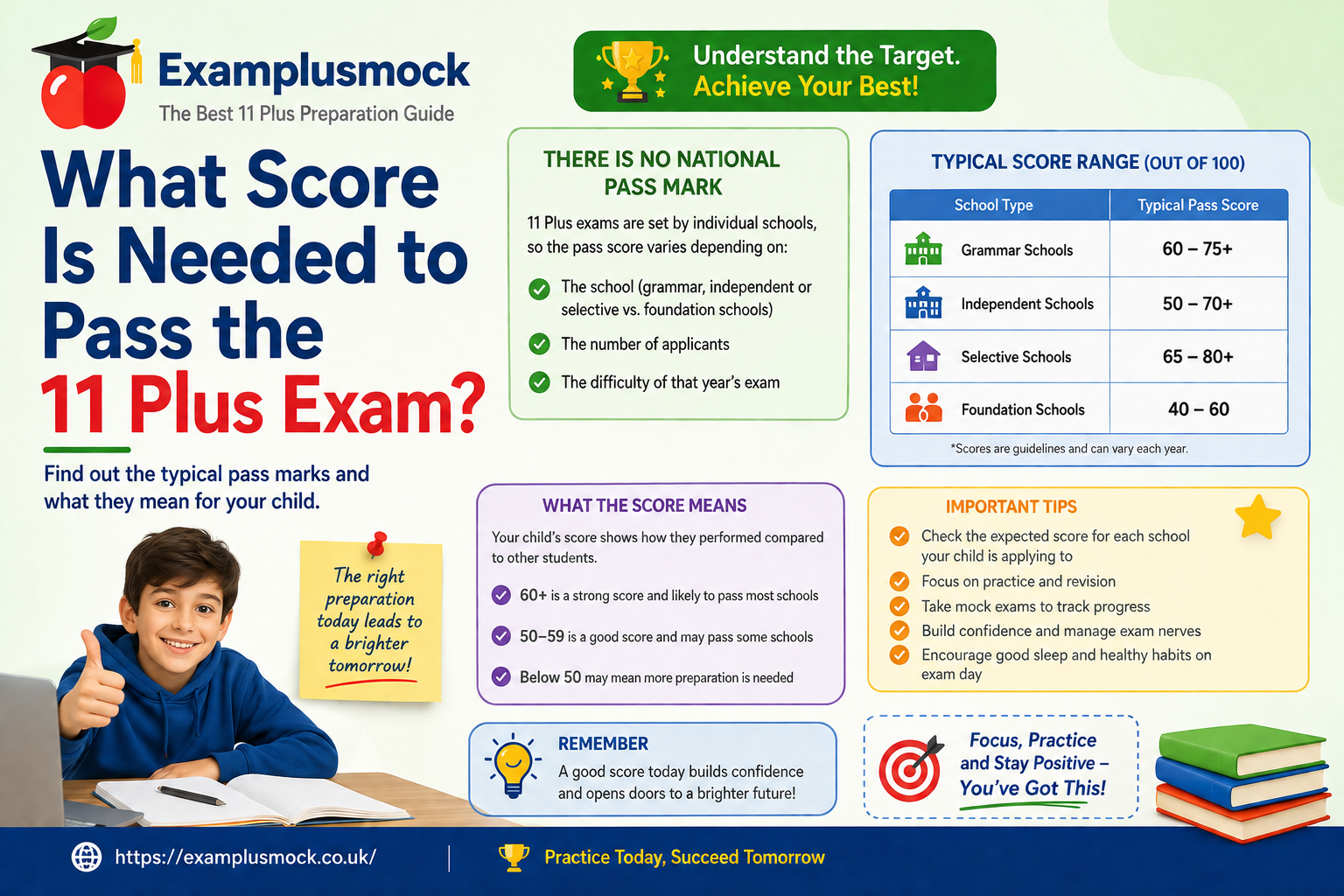
What Score Is Needed to Pass the 11 Plus Exam?
Preparing for the 11+ exam can be an exciting yet challenging journey for both children and parents. One of the most common questions families ask is, “What score is needed to pass the 11+ exam?” While it seems like a straightforward question, the answer is more complex than many people expect. Unlike standard school exams, there is usually no single national pass mark. Instead, each grammar school or local authority sets its own admission criteria, making the required 11 Plus Pass Score different depending on where your child applies.
Many parents mistakenly believe that achieving a certain percentage guarantees a grammar school place. In reality, admission depends on several factors, including your child’s exam performance, the number of available places, the number of applicants, and the specific scoring system used by the school. This means a score that is considered excellent in one area may not be enough in another.
Understanding how the scoring system works helps families set realistic expectations and prepare more effectively. Rather than focusing only on achieving a specific mark, children should aim to perform consistently well across all tested subjects. Strong preparation, regular revision, and realistic mock exams usually have a much greater impact than worrying about a particular score. This guide explains how the 11 Plus Pass Score is determined, why it varies between grammar schools, and what parents can do to maximize their child’s chances of success.
Is There an Official Pass Mark for the 11+ Exam?
One of the biggest misconceptions about the 11+ exam is that there is a single national pass mark. In reality, there is no official score that guarantees entry to every grammar school.
Each grammar school or local authority decides:
- Which exam provider to use.
- Which subjects to assess.
- How papers are marked.
- How scores are standardized.
- How places are allocated.
Because of these differences, the required 11 Plus Pass Score varies considerably across the UK. Some schools receive several times more applications than available places. Even if many children achieve high scores, only those with the strongest overall results may receive offers. For this reason, parents should research the admission policies of each grammar school before beginning preparation.
How Is the 11+ Exam Scored?
Most grammar schools use a standardized scoring system rather than simply calculating the percentage of correct answers.
Standardization helps create fairness by considering factors such as:
- The child’s age.
- Overall performance of all candidates.
- Difficulty of the examination.
- Consistency across different test papers.
This means two children answering the same number of questions correctly may receive slightly different scores after standardization. Instead of concentrating only on percentages, families should understand how the scoring process works within their chosen grammar schools. A strong 11 Plus Pass Score usually reflects both academic ability and performance compared with other candidates taking the same examination.
Why Does the Required Score Vary?
The required score changes from one grammar school to another because demand varies. Schools with an excellent academic reputation often receive a much higher number of applications.
Several factors influence the required score:
- Number of available places.
- Number of applicants.
- Overall performance of candidates.
- Local admission policies.
- Catchment area requirements.
For example, one grammar school may have 180 places available but receive over 1,000 applications. Another school may receive fewer applications, resulting in a different admission threshold. This is why parents should avoid comparing scores from different counties or grammar schools.
What Is Considered a Good 11+ Score?
Although there is no universal passing mark, achieving a high score greatly improves a child’s chances of receiving an offer.
A good 11 Plus Pass Score generally demonstrates the following:
- Strong English skills.
- Accurate Mathematics knowledge.
- Good Verbal Reasoning ability.
- Effective Non-Verbal Reasoning skills.
- Excellent time management.
- Consistent performance across every paper.
Rather than aiming for the minimum required score, children should work towards performing as well as possible in every subject. Consistent preparation usually leads to better overall results than concentrating only on reaching a specific numerical target.
How Mock Exams Help Improve Scores
One of the best ways to improve a child’s performance is through realistic mock examinations.
Mock exams allow children to:
- Experience timed conditions.
- Improve exam confidence.
- Develop effective pacing.
- Identify weaker subjects.
- Practice answering unfamiliar questions.
- Reduce exam anxiety.
Regular mock exams also help parents monitor progress throughout the preparation period. Instead of relying only on revision books, children benefit from applying their knowledge under realistic examination conditions.
Families looking for structured preparation and realistic mock exams can explore:
These resources help children understand the format of the examination while improving confidence before the real test.
Which Subjects Influence the Final Score?
The subjects included in the examination depend on the grammar school and exam provider.
Most 11+ examinations assess combinations of:
- English.
- Mathematics.
- Verbal Reasoning.
- Non-Verbal Reasoning.
Children should avoid focusing on only one subject. Balanced preparation helps improve the overall 11 Plus Pass Score because grammar schools assess a broad range of academic skills. Parents should create a revision timetable that gives sufficient time to every subject while also allowing opportunities for rest and regular practice.
Can Children Still Gain Admission Without the Highest Score?
Many parents worry that children must achieve the highest possible mark to receive a grammar school place. In reality, admission depends on several factors beyond the examination score.
These may include:
- Catchment area.
- School admission policy.
- Number of available places.
- Priority categories.
- Overall ranking of applicants.
Children should therefore focus on achieving their personal best rather than comparing themselves with other candidates. Following a consistent revision plan, practicing regularly, and maintaining confidence often contribute more to success than becoming anxious about reaching a particular score.
How Parents Can Support Better Results
Parents have an important role throughout the preparation journey.
Helpful ways to support children include:
- Creating a realistic revision timetable.
- Encouraging daily reading.
- Practising vocabulary regularly.
- Completing weekly Maths exercises.
- Using realistic mock exams.
- Reviewing mistakes calmly.
- Celebrating progress instead of perfection.
A supportive home environment allows children to prepare with confidence while gradually improving their overall performance. Developing strong study habits over several months usually has a greater impact on the final 11 Plus Pass Score than last-minute revision.
Common Mistakes That Can Affect the Final Score
Many children have the knowledge needed to perform well but lose valuable marks because of avoidable mistakes. Recognizing these errors early allows parents and children to address them before the actual examination.
Some of the most common mistakes include:
- Spending too long on one difficult question.
- Rushing through easier questions.
- Not reading instructions carefully.
- Ignoring time management.
- Revising only favorite subjects.
- Completing too few mock exams.
- Becoming anxious after one difficult section.
Avoiding these mistakes can have a positive impact on the final 11 Plus Pass Score. Children who practice regularly under timed conditions usually become better at managing pressure and making sensible decisions during the examination.
How to Improve Your Child’s Score Before Exam Day
Improving performance does not always require studying for longer hours. Instead, children should focus on improving the quality of their revision.
Effective preparation includes:
- Reading every day to strengthen comprehension.
- Expanding vocabulary through regular practice.
- Revising Mathematics topics consistently.
- Completing Verbal and Non-Verbal Reasoning exercises.
- Taking one mock exam every one or two weeks.
- Reviewing mistakes after every practice paper.
- Following a balanced revision timetable.
Children who revise consistently over several months often achieve a stronger 11 Plus Pass Score than those who rely on intensive revision shortly before the examination.
Should Parents Focus Only on the Pass Score?
While it is natural to think about the required 11 Plus Pass Score, parents should avoid making the examination entirely about marks and instead focus on building their child’s confidence, skills, and overall preparation.
The 11+ preparation journey helps children develop valuable lifelong skills, including:
- Independent learning.
- Problem-solving.
- Critical thinking.
- Reading confidence.
- Time management.
- Self-discipline.
- Resilience.
These skills continue to benefit children throughout secondary school and beyond.
Rather than asking only, “What 11 Plus Pass Score is needed?”, parents should encourage children to enjoy learning and celebrate the progress they make throughout their preparation.
Additional Learning Resources
Children perform best when they use a combination of quality learning materials, realistic mock exams, and consistent revision to improve their understanding and increase their chances of achieving the required 11 Plus Pass Score.
Useful resources include:
- https://examplusmock.co.uk/
- https://examplusmock.co.uk/11-plus-mock-tests/
- https://examplusmock.co.uk/contact-us/
- https://www.bbc.co.uk/bitesize
- https://www.gov.uk/schools-admissions
These resources provide valuable information about grammar school admissions, subject preparation, revision techniques, and realistic mock examinations that help children prepare with confidence.
Frequently Asked Questions
What is considered a good 11 Plus Pass Score?
There is no single score that guarantees admission to every grammar school because each school sets its own admission criteria. A good 11 Plus Pass Score depends on the school’s standardised scoring system, the number of applicants, and the number of available places. Rather than aiming for a particular percentage, children should focus on achieving their highest possible performance across every subject while developing strong exam techniques through regular practice.
Do all grammar schools use the same scoring system?
No. Grammar schools and local authorities often use different exam providers and different methods for standardising scores. Some schools use GL Assessment, while others use FSCE or their own entrance examinations. Because of these differences, the required 11 Plus Pass Score varies between schools. Parents should always read the admissions policy of each grammar school to understand how scores are calculated and how places are allocated.
Can mock exams improve my child’s score?
Yes. Mock exams are one of the most effective preparation tools because they recreate real examination conditions. They help children improve confidence, develop time management skills, identify weaker subjects, and become familiar with different question types. Regular mock exams also allow parents to monitor progress and focus revision on areas that need improvement before the final examination, increasing the likelihood of achieving a stronger 11 Plus Pass Score.
Should my child focus more on English or Maths?
Children should prepare for every subject included in the examination. Most grammar schools assess English, Mathematics, Verbal Reasoning, and Non-Verbal Reasoning, so balanced preparation is essential. Concentrating only on one subject may reduce overall performance. A consistent revision timetable that covers every area gives children the best opportunity to achieve a competitive 11 Plus Pass Score and perform confidently on exam day.
What is the best way to prepare for the 11+ exam?
The most effective preparation combines daily reading, vocabulary development, regular Mathematics practice, reasoning exercises, and realistic mock exams. Children should revise consistently over several months rather than relying on last-minute study. Reviewing mistakes, improving time management, and following a structured revision plan all contribute to a stronger 11 Plus Pass Score while helping children build confidence before the examination.
Conclusion
There is no universal score that guarantees success in the 11+ examination because every grammar school uses its own admission process. Understanding how the scoring system works allows parents to prepare more effectively and set realistic expectations. Rather than focusing only on achieving a particular 11 Plus Pass Score, families should concentrate on building strong academic skills, improving confidence, and developing effective exam techniques. Consistent revision, daily reading, vocabulary development, and realistic mock exams all contribute to better performance.
With careful planning, regular practice, and positive parental support, children can understand the 11 Plus Pass Score requirements, approach the 11+ examination feeling confident, well prepared, and ready to achieve their full potential.