
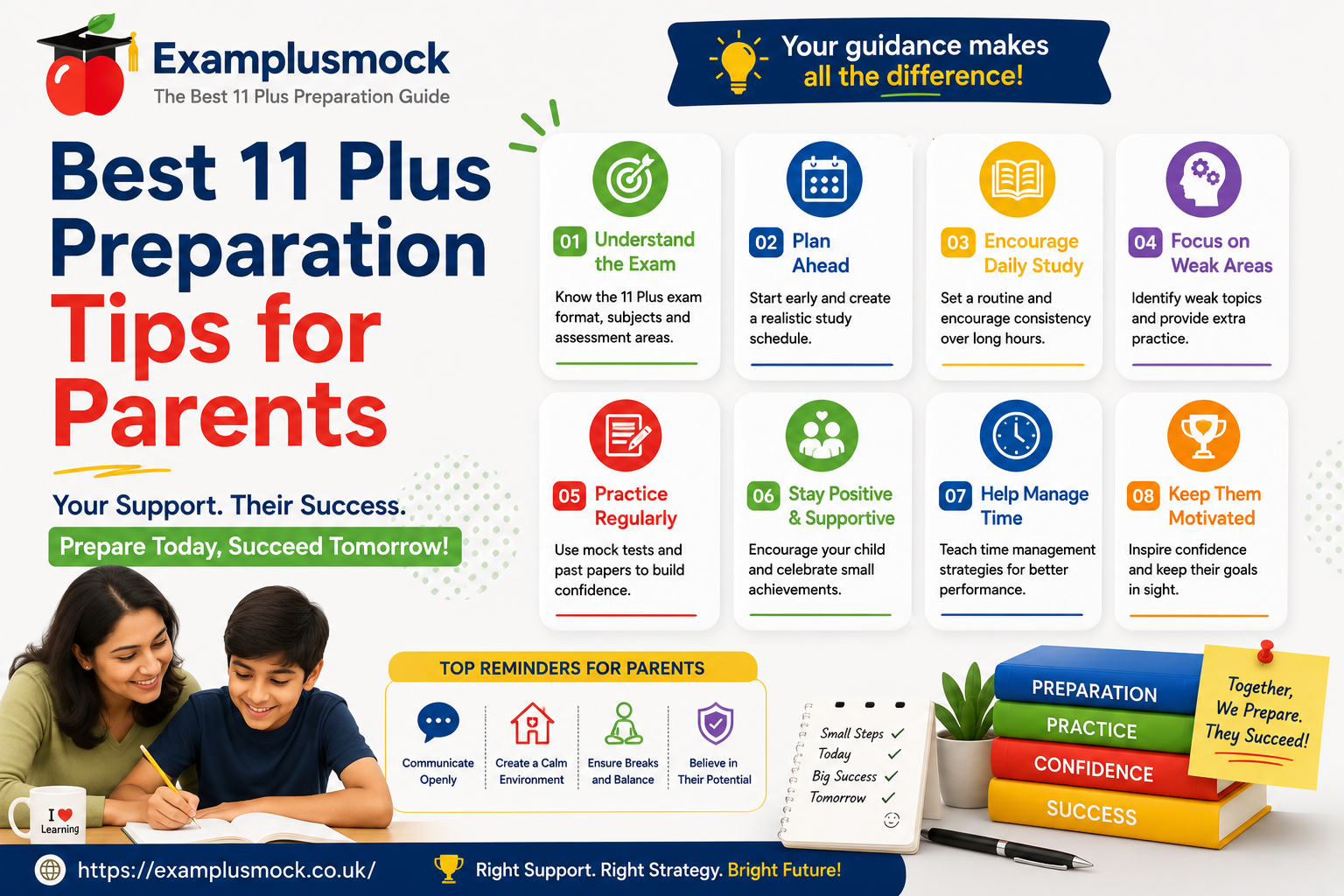
Best 11 Plus Preparation Tips for Parents
Preparing for the 11+ exam can feel overwhelming for both children and parents. With competition for grammar school places increasing in many areas, families often wonder how they can give their child the best possible chance of success. The good news is that effective preparation does not require endless hours of studying. Instead, following the right 11 Plus Preparation Tips can help children build knowledge, confidence, and exam skills gradually.
The 11+ exam is designed to assess a child’s academic ability, reasoning skills, and potential for success in grammar school. It often includes English, Mathematics, Verbal Reasoning, and Non-Verbal Reasoning, although the exact format varies between schools and examination boards. Because of this variation, parents should first understand the requirements of their chosen grammar schools before planning revision. Many successful candidates begin preparing several months before the examination. They follow a balanced study routine, complete regular practice papers, improve their reading habits, and learn how to manage their time effectively. These 11 Plus Preparation Tips allow children to strengthen weaker areas while maintaining confidence throughout the preparation journey.
Parents also play an essential role. A supportive home environment, realistic expectations, and positive encouragement often have a greater impact than intensive revision alone. Rather than focusing only on scores, families should celebrate progress and help children develop strong learning habits that will benefit them long after the examination. This guide shares practical 11 Plus Preparation Tips that parents can use to help their child prepare confidently and maximize their chances of grammar school success.
Why Parents Play a Key Role in 11+ Success
Parents are a child’s first teachers, and their support has a significant influence during 11+ preparation. While tutors and teachers provide valuable academic guidance, daily encouragement at home helps children stay motivated and develop positive attitudes towards learning. Children often feel nervous about grammar school entrance exams. Parents can reduce anxiety by focusing on effort rather than perfection and by creating a calm learning environment.
Effective 11 Plus Preparation Tips for parents include:
-
Encouraging consistent study habits.
-
Praising improvement rather than only high scores.
-
Helping children organize revision time.
-
Providing a quiet place to study.
-
Supporting healthy daily routines.
-
Listening to concerns without creating additional pressure.
Children who feel supported are more likely to remain confident throughout the preparation process. Parents should also remember that every child learns differently. Some may improve quickly in Maths, while others need more time to build vocabulary or reasoning skills. Patience and flexibility are key to long-term success.
Creating a Realistic Revision Plan
One of the most valuable 11 Plus Preparation Tips is to create a structured revision timetable. A clear plan helps children cover every subject while preventing last-minute cramming. Rather than studying for several hours at once, shorter sessions spread throughout the week are usually far more effective.
A balanced weekly timetable may include:
-
Two English sessions.
-
Two Maths sessions.
-
One Verbal Reasoning session.
-
One Non-Verbal Reasoning session.
-
Daily vocabulary practice.
-
One mock exam or practice paper.
-
One revision session to review mistakes.
Example timetable:
Monday
-
English comprehension
-
Vocabulary review
Tuesday
-
Mathematics practice
-
Mental arithmetic
Wednesday
-
Verbal Reasoning exercises
-
Reading session
Thursday
-
Non-Verbal Reasoning
-
Grammar revision
Friday
-
Mixed subject review
-
Vocabulary quiz
Saturday
-
Timed practice paper
Sunday
-
Mock exam review
-
Correct mistakes
-
Prepare for next week
Children preparing with organized 11 Plus Preparation Tips often remain more motivated because they can clearly see their progress.
Understanding the 11 Plus Exam Format
Before purchasing revision materials, parents should understand which subjects are included in their chosen grammar school’s examination.
Most schools assess combinations of the following:
-
English
-
Mathematics
-
Verbal Reasoning
-
Non-Verbal Reasoning
Some schools include all four subjects, while others only assess English and Maths.
Parents should also learn:
-
Number of examination papers.
-
Question styles.
-
Time allowed.
-
Marking methods.
-
Exam provider.
Understanding the exam structure allows families to apply 11 Plus Preparation Tips more effectively because revision can focus on the skills that will actually be tested.
Children also feel less anxious when they know exactly what to expect on exam day.
Building Strong Reading Habits
Reading is one of the simplest yet most powerful 11 Plus Preparation Tips because it improves several skills at the same time.
Children who read regularly often develop:
-
Better comprehension.
-
Stronger vocabulary.
-
Improved spelling.
-
Better grammar.
-
Greater concentration.
-
Wider general knowledge.
Parents should encourage reading for enjoyment rather than treating it only as revision.
Good reading materials include the following:
-
Children’s novels.
-
Adventure stories.
-
Historical fiction.
-
Science magazines.
-
Newspapers.
-
Biographies.
-
Educational websites.
After reading, ask questions such as:
-
What happened first?
-
Why did the character behave that way?
-
What new words did you learn?
-
Can you summarize the passage?
These conversations strengthen comprehension while making reading enjoyable. Even twenty minutes of reading each day can significantly improve English performance over several months.
Improving Vocabulary Every Day
Vocabulary plays an important role in English and Verbal Reasoning. Children who understand a wider range of words usually answer questions more accurately and complete papers more confidently. One of the easiest 11 Plus Preparation Tips is to make vocabulary learning part of everyday life.
Parents can encourage children to:
-
Learn five new words each day.
-
Use flashcards.
-
Keep a vocabulary notebook.
-
Play word games.
-
Read newspapers together.
-
Use new words in conversations.
When introducing new vocabulary, focus on:
-
Meaning.
-
Pronunciation.
-
Synonyms.
-
Antonyms.
-
Using the word in a sentence.
Learning words gradually helps children remember them for longer. Rather than memorising long lists, children should understand how words are used in different contexts.
Helping Children Master Maths Skills
Mathematics is another key area assessed in many grammar school entrance examinations. Children preparing successfully usually develop both calculation skills and logical thinking.
Important topics include:
-
Addition.
-
Subtraction.
-
Multiplication.
-
Division.
-
Fractions.
-
Decimals.
-
Percentages.
-
Ratios.
-
Word problems.
-
Geometry.
Parents should encourage children to explain how they solved problems instead of simply giving answers.
Useful 11 Plus Preparation Tips for Maths include:
-
Practicing mental arithmetic daily.
-
Completing short calculation drills.
-
Reviewing incorrect answers.
-
Solving word problems together.
-
Using timed exercises to improve speed.
Confidence grows when children solve a variety of question types regularly.
Supporting Verbal and Non-Verbal Reasoning
Reasoning questions are unfamiliar to many children because they focus on problem-solving rather than classroom learning. Verbal Reasoning tests language-based logic, while Non-Verbal Reasoning assesses visual and spatial thinking.
Children should practice:
Verbal Reasoning
-
Synonyms.
-
Antonyms.
-
Letter sequences.
-
Word codes.
-
Analogies.
-
Logical relationships.
Non-Verbal Reasoning
-
Shape patterns.
-
Rotations.
-
Reflections.
-
Symmetry.
-
Spatial awareness.
-
Missing shapes.
Regular exposure to these question types helps children recognize patterns more quickly. One of the most effective 11 Plus Preparation Tips is to include reasoning practice every week rather than leaving it until the final months before the exam.
Using Mock Exams Effectively
Mock exams are among the most valuable 11 Plus Preparation Tips because they prepare children for the experience of sitting the real examination. Unlike ordinary practice papers, mock exams recreate realistic exam conditions, helping children develop confidence, improve timing, and become familiar with working under pressure.
Regular mock exams allow children to:
-
Experience timed conditions.
-
Improve concentration.
-
Build confidence.
-
Develop better pacing.
-
Identify weaker subjects.
-
Reduce exam anxiety.
Parents should encourage children to treat every mock exam as though it were the real test. This helps build positive habits and prepares them for the expectations of exam day.
After every mock exam, review:
-
Incorrect answers.
-
Time spent on each section.
-
Topics requiring further revision.
-
Progress compared with previous papers.
Families looking for realistic mock examinations and professional preparation support can explore:
Combining regular revision with high-quality mock exams is one of the most effective 11 Plus Preparation Tips for helping children develop confidence, strengthen weaker areas, and approach the grammar school entrance examination fully prepared.
Teaching Good Time Management
Good time management is one of the most valuable 11 Plus Preparation Tips because children must complete a large number of questions within strict time limits. Even well-prepared students can lose marks if they spend too long on difficult questions. Parents can help children develop better timing by introducing regular timed activities during revision rather than waiting until the final weeks before the exam.
Helpful strategies include:
-
Answer easier questions first.
-
Skip difficult questions and return later if time allows.
-
Avoid spending several minutes on one question.
-
Keep an eye on the clock without becoming distracted.
-
Leave a few minutes to review answers.
Timed practice activities may include:
-
Ten-minute vocabulary challenges.
-
Fifteen-minute Maths drills.
-
Timed comprehension passages.
-
Short Verbal Reasoning quizzes.
-
Mini Non-Verbal Reasoning tests.
Children should also learn that accuracy is just as important as speed. Rushing often leads to careless mistakes, while working too slowly can leave sections unfinished. One of the most practical 11 Plus Preparation Tips is to help children find a comfortable pace that allows them to answer confidently within the available time.
Creating a Positive Learning Environment
The atmosphere at home has a significant impact on a child’s preparation. Children who feel supported and encouraged are usually more motivated and confident throughout the revision process. Parents should remember that every child learns differently. Some topics may require extra practice, while others improve naturally over time.
Ways to create a positive learning environment include:
-
Praising effort as well as results.
-
Celebrating small improvements.
-
Keeping revision sessions calm and organized.
-
Allowing regular breaks.
-
Encouraging children to ask questions.
-
Maintaining realistic expectations.
One of the most effective 11 Plus Preparation Tips is to focus on long-term improvement rather than expecting perfect scores in every practice paper. Confidence grows when children recognise their progress and understand that mistakes are part of learning.
Common Mistakes Parents Should Avoid
Parents naturally want the best for their children, but some well-intentioned actions can increase stress and reduce motivation.
Common mistakes include:
-
Leaving preparation until the last minute.
-
Comparing children with friends or siblings.
-
Focusing only on mock exam scores.
-
Ignoring weaker subjects.
-
Expecting long revision sessions every day.
-
Skipping regular breaks.
-
Introducing too many new resources at once.
Instead, families should follow balanced 11 Plus Preparation Tips that encourage consistency and gradual improvement. Children learn more effectively when revision is structured, enjoyable, and varied. Reviewing mistakes, discussing difficult questions, and adjusting the study plan when necessary often produces much better results than increasing study hours.
Healthy Habits That Improve Performance
Academic preparation is only one part of exam success. Healthy daily habits also improve concentration, memory, and emotional well-being.
Children preparing for grammar school entrance examinations should aim to:
-
Sleep for the recommended number of hours each night.
-
Eat balanced meals.
-
Drink plenty of water.
-
Stay physically active.
-
Spend time outdoors.
-
Take regular breaks during revision.
Parents should also encourage children to maintain hobbies and spend time with family and friends. A healthy balance between study and relaxation prevents burnout and helps children remain motivated. The evening before the examination should be calm. Rather than introducing new topics, children should review key notes briefly, organize everything needed for the next day, and get a good night’s sleep. These healthy routines are among the most overlooked 11 Plus Preparation Tips, yet they can make a significant difference to confidence and performance.
Additional Learning Resources
Using a variety of reliable resources helps children experience different question styles while reinforcing classroom learning.
Useful resources include:
These websites provide valuable information about grammar school admissions, educational guidance, revision materials, and realistic mock exams that support effective preparation. Parents should choose resources carefully and avoid overwhelming children with too many books or websites. Using a smaller number of high-quality materials consistently is usually more beneficial than constantly changing revision resources.
Frequently Asked Questions
When should parents start preparing their child for the 11+ exam?
Most education specialists recommend beginning preparation during Year 4 or early Year 5. Starting early allows children to build skills gradually without feeling overwhelmed. Following structured 11 Plus Preparation Tips over several months gives enough time to improve vocabulary, strengthen Maths skills, practice reasoning questions, and complete mock exams. Early preparation also helps children become familiar with exam formats while reducing stress as the examination date approaches.
How many hours should children study each week?
The ideal amount depends on the child’s age and current ability. Most children benefit from four to seven hours of focused revision each week during the early stages of preparation. As the examination approaches, study time may increase slightly. One of the most effective 11 Plus Preparation Tips is to prioritize consistent, high-quality study sessions rather than long periods of revision that lead to tiredness and reduced concentration.
Are mock exams really necessary?
Yes. Mock exams are one of the most valuable 11 Plus Preparation Tips because they recreate realistic exam conditions. They help children improve time management, reduce anxiety, and become familiar with working under pressure. Mock exams also identify strengths and weaknesses, allowing parents to adjust revision plans accordingly. Reviewing mistakes after each mock exam provides valuable learning opportunities and increases confidence before the real examination.
Should parents hire a tutor?
Tutors can provide additional support, but they are not essential for every child. Many children prepare successfully using quality revision materials, structured study plans, regular mock exams, and strong parental support. The most important 11 Plus Preparation Tips involve consistency, daily reading, vocabulary development, and balanced revision. Parents should consider tutoring if their child requires additional guidance in specific subjects or needs extra confidence before the examination.
How can parents keep children motivated during preparation?
Parents can maintain motivation by setting realistic goals, celebrating improvements, and creating a positive learning environment. Children should feel encouraged rather than pressured throughout their preparation journey. Following practical 11 Plus Preparation Tips, such as using varied activities, allowing regular breaks, and recognising effort as well as achievement, helps children remain engaged. Positive encouragement builds confidence and supports steady academic progress over time.
Conclusion
Preparing for the grammar school entrance examination is a journey that requires planning, patience, and consistency. By following practical 11 Plus Preparation Tips, parents can help children develop strong academic skills while building the confidence needed to perform well on exam day. A balanced revision timetable, daily reading, vocabulary development, regular reasoning practice, realistic mock exams, and healthy study habits all contribute to long-term success. Parents should focus on encouraging steady improvement, reviewing mistakes, and maintaining a calm learning environment rather than expecting perfection.
Most importantly, every child develops at their own pace. With consistent support, quality learning resources, and effective 11 Plus Preparation Tips, children can approach the examination feeling prepared, confident, and ready to achieve their goal of gaining a place at grammar school.