
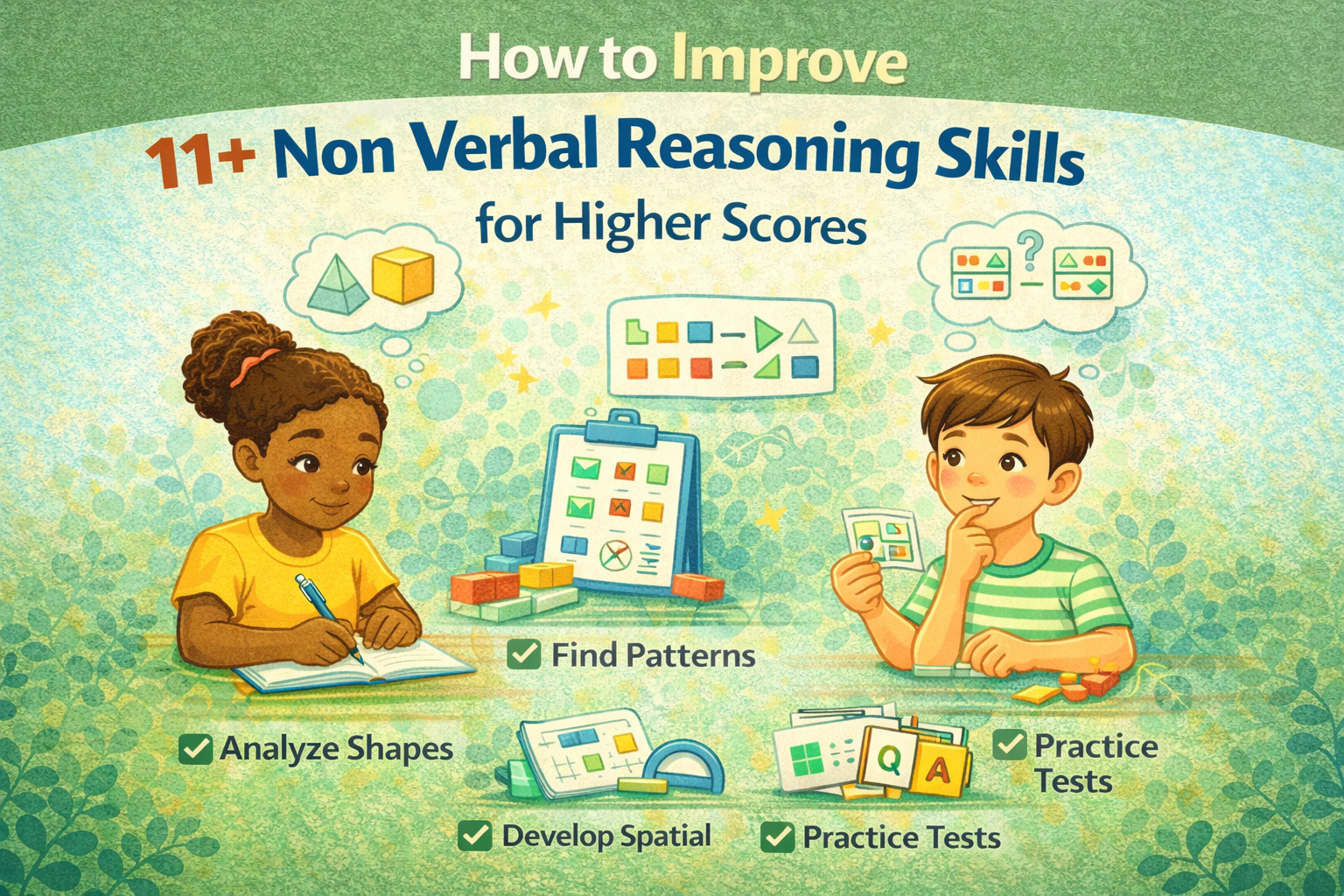
Improve 11 Plus Non Verbal Reasoning Skills for Better Results
Why Parents Need to Improve 11 Plus Non Verbal Reasoning
improve 11 plus non verbal reasoning is an essential focus area for parents preparing their child for the 11+ exam. Non-verbal reasoning tests a child’s ability to recognise patterns, shapes, and visual sequences without relying on language. Many students find this section challenging because it requires logical thinking and quick decision-making.
When parents actively work to improve 11-plus nonverbal reasoning, children become faster at identifying patterns and solving problems. This skill is especially important in GL Assessment exams where time pressure is high.
If you consistently aim to improve 11-plus nonverbal reasoning, your child will develop stronger analytical skills and perform better in exams.
Understanding Non Verbal Reasoning Question Types
Before you improve 11 plus non verbal reasoning, it is important to understand the common question types:
- Shape sequences
- Pattern completion
- Rotation and reflection
- Odd one out
- Code and transformation
Understanding these patterns helps children approach questions confidently and improves their ability to improve 11 plus non verbal reasoning.
Build Strong Visual Analysis Skills
To improve 11 plus non verbal reasoning, children must develop strong visual analysis skills. This means learning to observe details quickly and accurately.
Parents should encourage:
- Identifying differences in shapes
- Recognising repeating patterns
- Practising visual puzzles
These skills form the foundation to improve 11 plus non verbal reasoning.
Practise Non Verbal Reasoning Daily
Regular practice is essential to improve 11 plus non verbal reasoning. Children should practise:
- Mixed question types
- Timed exercises
- Increasing difficulty levels
Daily practice helps children become familiar with patterns and improves their ability to improve 11 plus non verbal reasoning.
Use Mock Exams to Improve Non Verbal Reasoning
Mock exams are one of the most effective ways to improve 11 plus non verbal reasoning. They provide real exam conditions and help children apply their skills under pressure.
Mock exams help:
- Improve speed and accuracy
- Identify weak areas
- Build confidence
Parents can use:
https://examplusmock.co.uk/
Regular mock exams are essential to improve 11 plus non verbal reasoning.
Improve Time Management Skills
Time pressure is a major challenge in non-verbal reasoning. To improve 11 plus non verbal reasoning, children must learn how to manage time effectively.
Parents should:
- Use timed practice sessions
- Teach children to skip difficult questions
- Encourage quick pattern recognition
Better time management helps improve 11 plus non verbal reasoning scores.
Teach Pattern Recognition Techniques
Pattern recognition is the core of non-verbal reasoning. To improve 11 plus non verbal reasoning, children should learn to:
- Identify repeating sequences
- Recognise rotations and reflections
- Break down complex patterns
These techniques help children solve questions faster and improve 11 plus non verbal reasoning.
Focus on Accuracy Before Speed
Accuracy is crucial when learning. To improve 11 plus non verbal reasoning:
- Encourage careful observation
- Avoid rushing
- Practise slowly at first
Once accuracy improves, speed can be increased.
Review Mistakes to Improve Performance
Reviewing mistakes is essential to improve 11 plus non verbal reasoning. Without review, children may repeat the same errors.
Parents should:
- Analyse incorrect answers
- Identify patterns in mistakes
- Practise similar questions
This helps children learn and improve 11-plus non verbal reasoning over time.
Use the Right Study Resources
Using quality materials helps improve 11-plus non verbal reasoning. Parents should use:
- Practice books
- Online mock exams
- Visual reasoning tools
For additional support:
https://www.bbc.co.uk/bitesize
The right resources make learning easier and more effective.
Role of Parents in Improving Non Verbal Reasoning
Parents play a key role in helping children improve 11-plus non verbal reasoning. They should:
- Monitor practice sessions
- Encourage consistency
- Provide feedback
- Motivate the child
Parental support helps children stay focused and improve faster.
Build Confidence in Non Verbal Reasoning
Confidence is essential to improve 11-plus non verbal reasoning. Children who feel confident perform better.
Parents can:
- Praise effort
- Celebrate progress
- Avoid criticism
Confidence helps children approach questions positively.
Create a Daily Practice Routine
Consistency is key to improving 11-plus non verbal reasoning. Parents should:
- Set a daily study schedule
- Include revision sessions
- Practise regularly
A structured routine ensures steady improvement.
Avoid Common Mistakes in Non Verbal Reasoning Preparation
Parents should avoid mistakes such as:
- Ignoring weak areas
- Not practising regularly
- Skipping mock exams
- Focusing only on easy questions
Avoiding these mistakes helps improve 11-plus non verbal reasoning effectively.
Long-Term Benefits of Non Verbal Reasoning Skills
When children improve 11-plus non verbal reasoning, they gain:
- Better logical thinking
- Strong analytical skills
- Improved academic performance
- Confidence in exams
These benefits extend beyond the 11+ exam.
When Should You Start Non Verbal Reasoning Preparation
Parents should start early to improve 11-plus non verbal reasoning:
- Year 4 for basic skills
- Year 5 for advanced practice
Early preparation gives children enough time to improve.
Conclusion
To improve 11-plus non verbal reasoning, parents must focus on regular practice, pattern recognition, and effective strategies. By using mock exams, improving time management, and reviewing mistakes, children can develop strong reasoning skills. A structured approach to improve 11-plus non verbal reasoning not only boosts exam performance but also builds confidence, helping children succeed in the 11+ exam.