
What Subjects Are Included in the 11 Plus Exam?
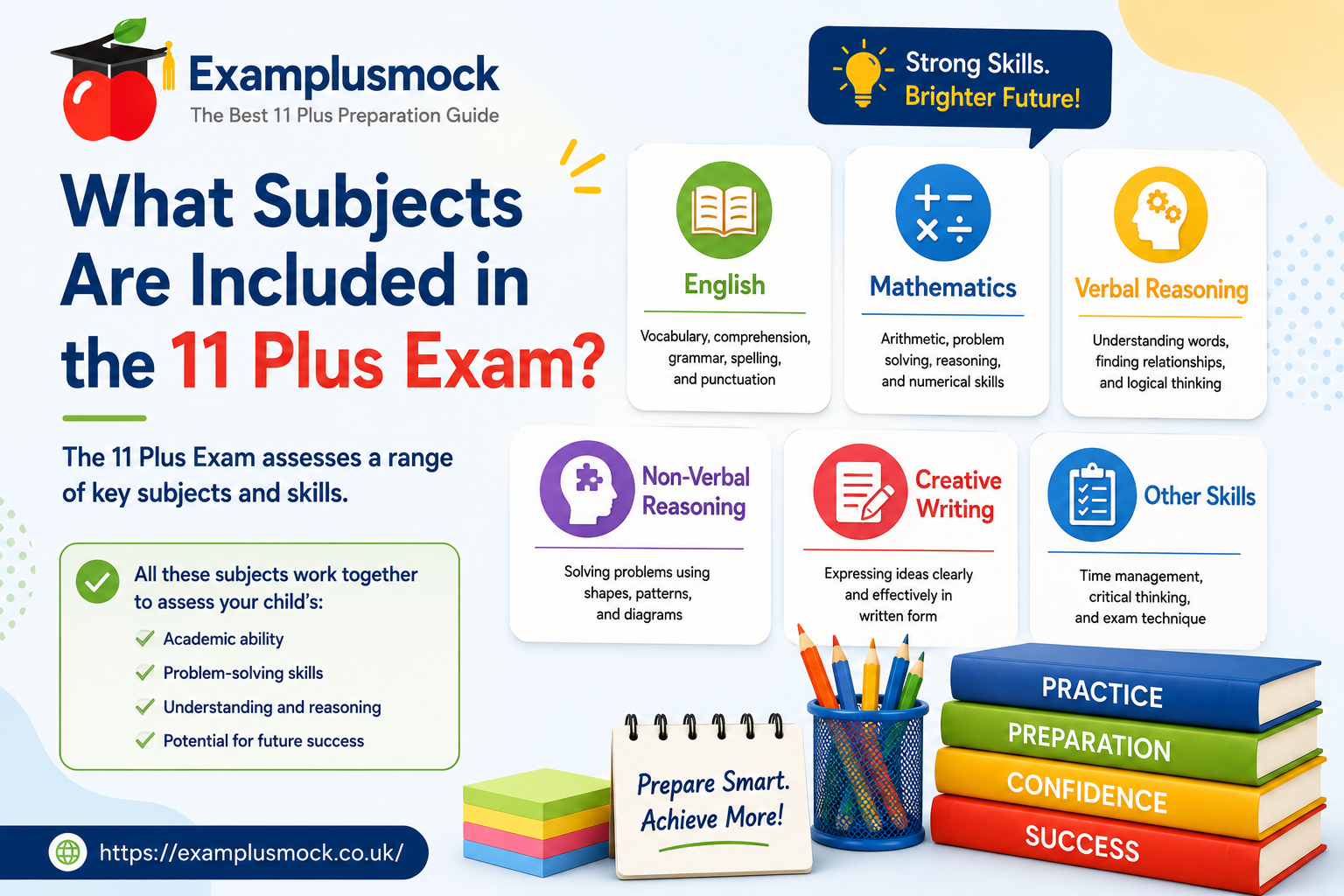
Parents preparing their children for grammar school often ask, “What are the 11 Plus Exam Subjects?” Understanding the 11 Plus Exam Subjects is one of the most important steps in building an effective revision plan. Although the exact format varies between grammar schools and exam providers, most 11+ exams assess four core areas: English, Mathematics, Verbal Reasoning, and Non-Verbal Reasoning.
Each subject is designed to measure different academic skills, including reading ability, mathematical reasoning, logical thinking, vocabulary, and problem-solving. Rather than testing what children have recently learned at school, the examination evaluates how well they can apply knowledge, think critically, and work efficiently under timed conditions.
Parents who understand the 11 Plus Exam Subjects can create a balanced study plan that strengthens every area instead of focusing on only one or two subjects. With consistent preparation, realistic mock exams, and quality learning resources, children can develop the confidence and skills needed to perform well on exam day.
Understanding the 11 Plus Exam Subjects
Grammar schools aim to identify pupils with strong academic potential. The 11 Plus Exam Subjects have therefore been chosen to assess a broad range of abilities rather than simply testing classroom knowledge.
The examination measures how children:
-
Read and understand information.
-
Solve mathematical problems.
-
Think logically.
-
Recognize patterns.
-
Apply knowledge under pressure.
-
Manage their time effectively.
Every subject contributes to building a complete picture of a child’s academic ability. Preparing each area equally gives children the best opportunity to achieve strong results.
Why Grammar Schools Test Different Subjects
Grammar schools look beyond school grades when selecting pupils. The 11 Plus Exam Subjects allow schools to assess several important skills that are valuable throughout secondary education.
These include:
-
Critical thinking.
-
Logical reasoning.
-
Reading accuracy.
-
Mathematical understanding.
-
Problem-solving ability.
-
Concentration.
-
Time management.
Testing multiple subjects ensures children demonstrate a balanced range of academic strengths rather than relying on performance in just one area.
English in the 11 Plus Exam
English is one of the most important 11 Plus Exam Subjects because it supports success across every part of the examination. Strong reading skills improve comprehension, vocabulary, reasoning, and even mathematical problem-solving.
Reading Comprehension
Reading comprehension tests a child’s ability to understand, analyse, and interpret written passages.
Children may need to:
-
Identify the main idea.
-
Find specific information.
-
Explain vocabulary in context.
-
Draw conclusions.
-
Understand the author’s purpose.
-
Make logical inferences.
Regular reading significantly improves comprehension performance.
Vocabulary
Vocabulary plays a major role throughout the 11 Plus Exam Subjects. Children with strong vocabularies usually understand questions more quickly and answer more accurately.
Parents can improve vocabulary by encouraging the following:
-
Daily reading.
-
Word games.
-
Flashcards.
-
Vocabulary notebooks.
-
Learning new words in context.
Expanding vocabulary gradually over several months is usually more effective than trying to memorise large word lists shortly before the exam.
Grammar
Grammar questions assess children’s understanding of written English.
Topics may include:
-
Sentence structure.
-
Parts of speech.
-
Punctuation.
-
Tenses.
-
Synonyms and antonyms.
-
Word usage.
Strong grammar helps children answer English questions confidently and improves writing accuracy.
Creative Writing (Where Applicable)
Some grammar schools include a creative writing task as part of the English assessment.
Children may be asked to write the following:
-
A story.
-
A descriptive paragraph.
-
A personal response.
-
A continuation of a given passage.
Parents should encourage children to practice planning ideas, organizing paragraphs, and using varied vocabulary.
Mathematics in the 11 Plus Exam
Mathematics is another core component of the 11 Plus Exam Subjects. Rather than testing only calculation skills, the exam often measures how well children apply mathematical knowledge to unfamiliar situations.
Number Skills
Children should feel confident with the following:
-
Addition.
-
Subtraction.
-
Multiplication.
-
Division.
-
Mental arithmetic.
-
Place value.
Quick and accurate calculation saves valuable time during the examination.
Fractions, Decimals and Percentages
Many math questions involve converting between fractions, decimals, and percentages.
Children should understand:
-
Equivalent fractions.
-
Simplifying fractions.
-
Percentage calculations.
-
Decimal conversions.
-
Comparing values.
These skills frequently appear in grammar school entrance examinations.
Word Problems
Problem-solving questions require children to interpret written information before selecting the correct mathematical method.
Strategies include:
-
Reading carefully.
-
Identifying important numbers.
-
Ignoring unnecessary information.
-
Showing work clearly.
-
Checking answers.
Word problems assess both reading and mathematical reasoning.
Mental Math
Mental math helps children answer straightforward calculations quickly.
Parents can encourage:
-
Times tables practice.
-
Daily number challenges.
-
Mental calculation games.
-
Quick-fire arithmetic quizzes.
Improved mental math skills leave more time for challenging questions.
Problem Solving
Many schools include multi-step questions that require children to combine different mathematical skills.
These questions encourage:
-
Logical thinking.
-
Planning.
-
Analytical reasoning.
-
Careful calculation.
Regular practice builds confidence and improves accuracy.
Verbal Reasoning Explained
Verbal reasoning is one of the most distinctive 11 Plus Exam Subjects because it measures how children think using language.
Rather than assessing curriculum knowledge, verbal reasoning evaluates logical thinking and language skills.
Common Question Types
Children may encounter the following:
-
Synonyms.
-
Antonyms.
-
Letter sequences.
-
Word relationships.
-
Hidden words.
-
Codes.
-
Analogies.
Initially these questions may appear unfamiliar, but regular practice makes them much easier.
Vocabulary Skills
Vocabulary has a direct impact on verbal reasoning performance.
Children with broader vocabularies often:
-
Understand instructions more quickly.
-
Recognize word relationships.
-
Complete questions faster.
-
Make fewer mistakes.
Daily reading remains one of the most effective vocabulary-building activities.
Logical Thinking
Logical thinking helps children solve unfamiliar questions using reasoning rather than memorization.
Parents can encourage logical thinking through the following:
-
Educational puzzles.
-
Strategy games.
-
Word challenges.
-
Pattern recognition activities.
These activities strengthen skills that extend beyond the examination itself.
Tips for Improvement
Children can improve verbal reasoning by:
-
Reading regularly.
-
Learning new vocabulary.
-
Completing timed practice.
-
Reviewing mistakes.
-
Revisiting difficult question types.
Consistency usually produces better results than occasional long revision sessions.
Non-Verbal Reasoning Explained
Non-Verbal Reasoning is one of the 11 Plus Exam Subjects that many children find unfamiliar because it focuses on visual rather than language-based reasoning.
These questions assess a child’s ability to recognize relationships between shapes, patterns, and diagrams.
Pattern Recognition
Children must identify how shapes change across a sequence.
Skills tested include:
-
Observation.
-
Logical thinking.
-
Visual analysis.
-
Attention to detail.
Pattern recognition improves through repeated exposure to different question styles.
Shape Sequences
Children may need to determine which shape logically completes a sequence.
Questions often involve:
-
Rotations.
-
Reflections.
-
Size changes.
-
Position changes.
-
Missing shapes.
Learning common sequence patterns makes these questions easier.
Rotations
Shape rotation questions require children to imagine objects turning in different directions.
Parents can support learning using:
-
Jigsaw puzzles.
-
Building blocks.
-
Visual reasoning books.
-
Interactive educational games.
Regular practice strengthens spatial awareness.
Mirror Images
Mirror image questions assess visual perception.
Children learn to identify:
-
Symmetry.
-
Reflections.
-
Shape orientation.
-
Directional changes.
These questions reward careful observation rather than speed alone.
Spatial Reasoning
Spatial reasoning measures how children understand relationships between objects in space.
Benefits of developing spatial skills include:
-
Better problem-solving.
-
Improved mathematical thinking.
-
Stronger logical reasoning.
-
Greater confidence in unfamiliar questions.
Consistent practice gradually improves both speed and accuracy.
Do All Grammar Schools Test the Same Subjects?
Although the four core 11 Plus Exam Subjects are common across most grammar schools, the exact combination varies depending on the school or exam provider.
Some schools assess:
-
English and Maths only.
-
English, Maths and Verbal Reasoning.
-
English, Maths and Non-Verbal Reasoning.
-
All four core subjects.
Parents should always check the admission requirements of each grammar school before beginning preparation.
Understanding which 11 Plus Exam Subjects are included allows families to focus their revision more effectively.
GL Assessment vs CEM Subjects
What GL Assessment Usually Includes
Many grammar schools use GL Assessment papers.
These commonly include:
-
English.
-
Mathematics.
-
Verbal Reasoning.
-
Non-Verbal Reasoning.
Questions are generally multiple choice and follow a predictable structure.
What CEM Usually Includes
Some schools previously used CEM-style assessments, which often placed greater emphasis on vocabulary, comprehension, and speed.
Children may encounter the following:
-
Advanced vocabulary.
-
Reading comprehension.
-
Numerical reasoning.
-
Mixed question formats.
Regardless of the provider, building strong foundations across all 11 Plus Exam Subjects remains the most effective preparation strategy.
Which Subject Is the Hardest?
The answer varies from child to child. Some children naturally excel in math but struggle with vocabulary, while others find reasoning questions more challenging than comprehension.
Parents should identify individual strengths and weaknesses early.
Commonly challenging areas include:
-
Verbal reasoning because of advanced vocabulary.
-
Non-Verbal Reasoning because of unfamiliar question styles.
-
Reading comprehension because of inference questions.
-
Multi-step math problems because they require careful analysis.
Rather than focusing only on difficult topics, children should continue revising every one of the 11 Plus Exam Subjects to maintain balanced progress.
How Parents Can Help Children Prepare for Every Subject
Parents play a vital role throughout preparation.
Helpful strategies include:
-
Creating a realistic revision timetable.
-
Encouraging daily reading.
-
Supporting vocabulary development.
-
Providing regular practice papers.
-
Reviewing mistakes calmly.
-
Offering positive encouragement.
Children are more likely to remain motivated when preparation feels supportive rather than stressful.
Creating a Balanced Study Plan
A balanced revision plan ensures each of the 11 Plus Exam Subjects receives enough attention throughout preparation.
An example weekly schedule could include:
-
Monday – English comprehension.
-
Tuesday – Mathematics.
-
Wednesday – Verbal Reasoning.
-
Thursday – Non-Verbal Reasoning.
-
Friday – Vocabulary review.
-
Saturday – Mixed practice paper.
-
Sunday – Revision and mistake analysis.
Small, consistent study sessions usually produce better results than long periods of intensive revision.
How Mock Exams Improve Subject Knowledge
Mock exams allow children to apply everything they have learned across all 11 Plus Exam Subjects under realistic exam conditions.
Benefits include:
-
Improved time management.
-
Better confidence.
-
Familiarity with exam formats.
-
Identification of weak subjects.
-
Increased exam readiness.
Parents looking for realistic preparation can explore the following:
Mock exam information is available at:
https://examplusmock.co.uk/11-plus-mock-tests/
Regular mock testing helps children measure progress, identify areas for improvement, and build confidence before sitting the real grammar school entrance examination.
Common Mistakes Children Make When Preparing for the 11 Plus Exam Subjects
Many children work hard but do not always prepare in the most effective way. Understanding these common mistakes can help parents guide their children towards better study habits and stronger exam performance. A balanced approach to the 11 Plus Exam Subjects is far more effective than focusing on only one area.
Focusing Only on Favourite Subjects
Some children spend most of their revision time on subjects they already enjoy, such as Maths or English, while neglecting reasoning papers. Since grammar schools often assess multiple 11 Plus Exam Subjects, every subject should receive regular attention.
A balanced revision program helps children:
-
Build confidence across all subjects.
-
Identify weaker areas early.
-
Develop consistent academic skills.
-
Improve overall exam performance.
Ignoring Time Management
Many children know the correct answers but struggle to finish papers within the allocated time.
Parents should encourage:
-
Timed practice papers.
-
Mini timed quizzes.
-
Stopwatch activities.
-
Regular mock exams.
Learning to work efficiently is just as important as learning the subject content.
Memorising Instead of Understanding
Memorising facts without understanding concepts can create difficulties when children face unfamiliar questions.
Parents should encourage children to:
-
Explain their answers.
-
Discuss different solving methods.
-
Ask questions.
-
Review mistakes carefully.
Understanding builds confidence and allows children to apply knowledge in different situations.
How Reading Improves Every 11 Plus Exam Subject
Reading is one of the simplest and most effective ways to strengthen performance across all 11 Plus Exam Subjects.
Children who read regularly often improve:
-
Vocabulary.
-
Reading comprehension.
-
Grammar.
-
Concentration.
-
General knowledge.
-
Critical thinking.
A wide variety of reading materials provides the greatest benefit.
Children should read:
-
Fiction.
-
Non-fiction.
-
Newspapers.
-
Science articles.
-
History books.
-
Children’s magazines.
Even twenty minutes of reading each day can produce noticeable improvements over several months.
Building Vocabulary for Long-Term Success
Vocabulary appears throughout the 11 Plus Exam Subjects, particularly in English and Verbal Reasoning.
Children with stronger vocabularies often:
-
Understand instructions faster.
-
Answer comprehension questions more accurately.
-
Recognize word relationships.
-
Improve reasoning performance.
-
Feel more confident during exams.
Parents can support vocabulary development through:
-
Flashcards.
-
Word games.
-
Reading together.
-
Daily discussions.
-
Learning one new word every day.
Vocabulary development is gradual, making early preparation especially valuable.
Why Practice Papers Matter
Practice papers help children become familiar with the structure and style of the 11 Plus Exam Subjects.
Benefits include:
-
Greater confidence.
-
Improved speed.
-
Better accuracy.
-
Familiarity with question formats.
-
Identification of weaker topics.
Parents should encourage children to review completed papers rather than simply checking scores.
Mistake analysis often provides the greatest learning opportunities.
How to Review Mistakes Effectively
Mistakes are a valuable part of the learning process.
Instead of simply marking answers as right or wrong, children should ask:
-
Why was the answer incorrect?
-
Which concept was misunderstood?
-
Could the question have been solved differently?
-
Will this mistake happen again?
Keeping a revision notebook for difficult questions helps children monitor progress over time.
The Importance of Confidence During Preparation
Confidence has a major influence on exam performance.
Children who believe they can succeed are more likely to remain calm and think clearly.
Parents can build confidence by:
-
Celebrating improvement.
-
Praising effort.
-
Setting realistic goals.
-
Avoiding unnecessary comparisons.
-
Maintaining positive routines.
Confidence develops gradually through consistent preparation across all 11 Plus Exam Subjects.
Using Online Resources to Support Learning
Modern educational resources provide excellent opportunities for additional practice.
Useful resources include:
These resources offer revision materials, mock exams, educational guidance, and additional learning support for families preparing for grammar school entrance examinations.
Signs Your Child Is Making Good Progress
Parents often wonder whether preparation is working.
Positive indicators include:
-
Improved mock exam scores.
-
Greater confidence.
-
Faster completion times.
-
Better vocabulary.
-
Improved reading ability.
-
Stronger reasoning skills.
-
Reduced exam anxiety.
Progress is rarely perfectly steady. Small improvements over time usually produce the strongest long-term results.
Final Revision Tips Before the 11 Plus Exam
The final weeks before the examination should focus on strengthening existing knowledge rather than introducing entirely new topics.
Helpful strategies include:
-
Revising difficult topics.
-
Completing realistic mock exams.
-
Reviewing previous mistakes.
-
Maintaining healthy sleep routines.
-
Eating balanced meals.
-
Staying physically active.
-
Taking regular breaks.
Parents should also encourage children to remain positive and avoid last-minute cramming. Balanced preparation produces better outcomes than excessive revision.
Additional Learning Resources
Families preparing for grammar school entrance exams can benefit from using trusted educational resources alongside their regular revision.
Recommended resources include:
Combining quality study materials with structured preparation helps children build confidence across all 11 Plus Exam Subjects.
Frequently Asked Questions
What are the main 11 Plus Exam Subjects?
The four main 11 Plus Exam Subjects are English, Mathematics, Verbal Reasoning, and Non-Verbal Reasoning. Some grammar schools assess all four subjects, while others may include only English and math or use different combinations depending on their admissions process. Parents should always check the entry requirements of each school before planning revision. A balanced study plan covering every tested subject helps children develop the broad range of skills needed for grammar school entrance examinations and improves confidence before exam day.
Is English harder than math on the 11 Plus exam?
Whether English or math is harder depends on the individual child. Some children naturally enjoy reading and vocabulary, while others perform better with numbers and calculations. English often requires strong comprehension and vocabulary skills, whereas math demands accuracy and problem-solving. Consistent practice in both areas is important because they form key parts of the 11 Plus Exam Subjects. Identifying strengths and weaknesses early allows parents to provide additional support where it is most needed.
Do all grammar schools include Verbal Reasoning?
No. Although many grammar schools assess Verbal Reasoning, not every school includes it as part of the admissions process. Some schools focus only on English and Mathematics, while others assess all four core 11 Plus Exam Subjects. Parents should research the examination format used by their preferred grammar schools before purchasing study materials. Preparing for the correct subjects ensures revision time is used efficiently and gives children the best opportunity for success.
How can parents help children prepare for every subject?
Parents can support preparation by creating a realistic revision timetable, encouraging daily reading, providing regular practice papers, reviewing mistakes calmly, and maintaining a positive learning environment. Quality mock exams also help children experience realistic exam conditions while identifying weaker areas. Supporting every one of the 11 Plus Exam Subjects rather than concentrating on only one or two areas helps children develop balanced academic skills and greater confidence before the examination.
How often should children revise the 11 Plus Exam Subjects?
Most education specialists recommend studying little and often rather than completing very long revision sessions. Children usually benefit from four to six study sessions each week, with every one of the 11 Plus Exam Subjects appearing regularly within the timetable. Timed practice papers, vocabulary development, reading, and mock exams should all be included alongside subject revision. Consistency is far more effective than last-minute cramming and helps children retain knowledge more successfully.
Conclusion
The 11 Plus Exam Subjects form the foundation of every grammar school entrance examination. By understanding what each subject assesses, parents can create a balanced revision plan that develops reading, mathematical ability, logical thinking, vocabulary, and problem-solving skills. Regular practice papers, realistic mock exams, daily reading, and consistent revision help children build confidence while identifying areas for improvement. Preparing all of the 11 Plus Exam Subjects equally gives children the strongest opportunity to perform well under exam conditions and achieve their grammar school ambitions. With structured preparation, positive encouragement, and quality learning resources, children can approach the examination feeling confident, well prepared, and ready to succeed.