
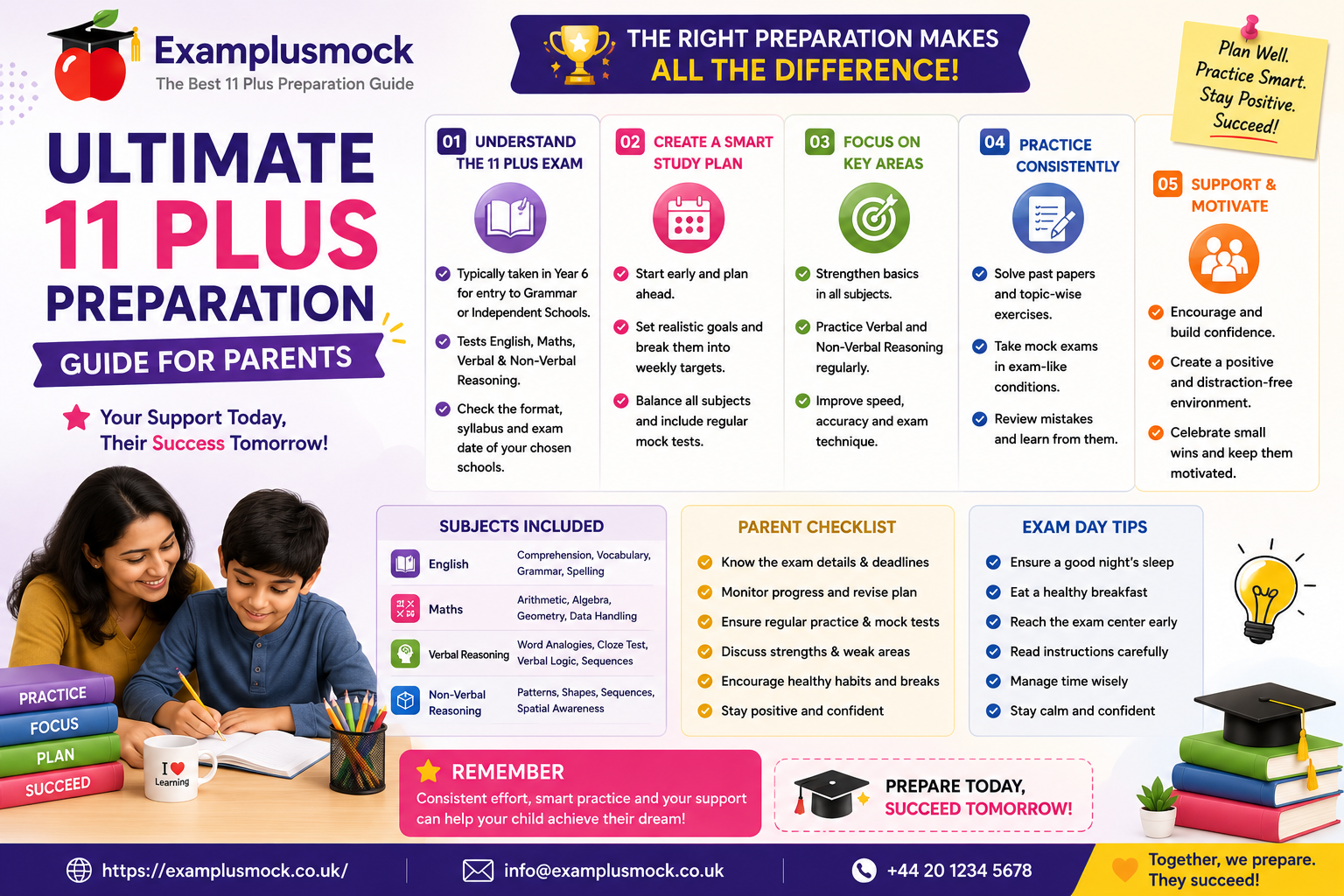
Ultimate 11 Plus Preparation Guide for Parents
Preparing for the 11+ exam is an important journey that requires planning, patience, and consistent effort. Many parents wonder when to begin preparation, how much revision their child should complete, and which resources will provide the greatest benefit. While every child learns differently, following a structured 11 Plus Preparation Guide can help families approach the process with confidence and reduce unnecessary stress.
The 11+ examination is designed to assess a child’s academic ability and readiness for grammar school education. Depending on the grammar school or local authority, the exam may include English, Mathematics, Verbal Reasoning, and Non-Verbal Reasoning. Success depends not only on subject knowledge but also on confidence, exam technique, vocabulary, time management, and regular practice.
Parents play a significant role throughout the preparation process. A supportive home environment, realistic expectations, and a well-organised revision timetable encourage children to develop good study habits while maintaining a healthy balance between learning and relaxation. This comprehensive 11 Plus Preparation Guide explains when to start preparing, how to organise revision, which resources to use, and how parents can support their children every step of the way.
Understand the 11+ Exam Before You Begin
Before creating a revision plan, parents should understand the structure of the examination used by their chosen grammar schools.
Different schools may assess:
-
English
-
Mathematics
-
Verbal Reasoning
-
Non-Verbal Reasoning
-
Creative Writing (some schools)
Some grammar schools use GL Assessment papers, while others use different examination providers or their own entrance tests. Understanding the format allows parents to build an effective 11 Plus Preparation Guide that focuses on the correct subjects and question styles.
Visit the grammar school’s admissions page carefully to understand:
-
Subjects included
-
Exam dates
-
Registration deadlines
-
Standardised scoring methods
-
Admission criteria
Research completed early prevents unnecessary confusion later in the preparation journey.
Start Preparation at the Right Time
One of the most common questions parents ask is when preparation should begin. Most children benefit from starting structured preparation during Year 4 or the beginning of Year 5. This allows plenty of time to build confidence without creating unnecessary pressure.
A gradual approach allows children to:
-
Develop reading habits.
-
Strengthen Maths skills.
-
Improve vocabulary.
-
Practise reasoning questions.
-
Build confidence through regular revision.
An effective 11 Plus Preparation Guide focuses on consistent progress rather than intensive last-minute revision. Short daily sessions are usually more productive than occasional long study periods.
Create a Realistic Revision Timetable
A well-organized timetable helps children cover every subject without feeling overwhelmed. Parents should divide revision across the week while including regular breaks and free time.
An example weekly timetable might include:
Monday
-
English Reading
-
Vocabulary Practice
Tuesday
-
Mathematics
-
Mental Arithmetic
Wednesday
-
Verbal Reasoning
Thursday
-
Non-Verbal Reasoning
Friday
-
Reading Comprehension
-
Creative Writing
Saturday
-
Timed Practice Paper
Sunday
-
Review Mistakes
-
Family Reading Session
A structured 11 Plus Preparation Guide ensures that every important skill receives regular attention throughout the year.
Encourage Daily Reading
Reading is one of the most valuable habits children can develop during 11+ preparation.
Regular reading improves:
-
Vocabulary
-
Comprehension
-
Grammar
-
Spelling
-
Writing skills
-
General knowledge
Parents should encourage children to read for at least twenty to thirty minutes each day.
Suitable reading materials include:
-
Children’s novels
-
Adventure stories
-
Historical fiction
-
Newspapers
-
Educational magazines
-
Science articles
-
Biographies
After reading, discuss the story together.
Ask questions such as:
-
What happened first?
-
Why did the character behave this way?
-
What new words did you learn?
-
Can you summarize the passage?
Daily reading forms a key part of every successful 11 Plus Preparation Guide because it supports nearly every area of the examination.
Develop Strong Vocabulary
Vocabulary plays a major role in English and Verbal Reasoning papers. Children with stronger vocabulary often understand questions more quickly and answer with greater confidence.
Parents can improve vocabulary by encouraging children to:
-
Learn five new words every day.
-
Write each word in a notebook.
-
Learn the meaning.
-
Find a synonym.
-
Find an antonym.
-
Use the word in a sentence.
Other helpful activities include:
-
Word games.
-
Crosswords.
-
Scrabble.
-
Vocabulary quizzes.
-
Reading aloud.
Building vocabulary gradually is an essential part of a complete 11 Plus Preparation Guide.
Strengthen Mathematics Skills
Mathematics is an important part of most grammar school entrance examinations.
Children should revise topics such as:
-
Addition
-
Subtraction
-
Multiplication
-
Division
-
Fractions
-
Percentages
-
Decimals
-
Ratios
-
Word problems
-
Measurement
-
Geometry
Daily practice helps children become more confident and improves calculation speed. Parents should encourage children to explain how they reached each answer rather than simply checking whether it is correct. Understanding mathematical methods is far more valuable than memorising procedures.
Practise Verbal and Non-Verbal Reasoning
Reasoning papers assess problem-solving rather than knowledge learned at school. Children should become familiar with common question types before attempting timed practice.
Verbal Reasoning often includes:
-
Synonyms
-
Antonyms
-
Letter sequences
-
Word relationships
-
Codes
-
Vocabulary questions
Non-Verbal Reasoning commonly includes:
-
Shape patterns
-
Rotations
-
Reflections
-
Matrices
-
Sequences
-
Visual reasoning
Regular practice allows children to recognize patterns more quickly and answer confidently during the examination. Including reasoning practice in your 11 Plus Preparation Guide helps children become comfortable with unfamiliar question formats.
Take Regular Mock Exams
Mock exams are one of the most valuable preparation tools available.
They help children:
-
Experience real exam conditions.
-
Improve time management.
-
Build confidence.
-
Identify weaker subjects.
-
Reduce exam anxiety.
-
Practice completing full papers.
Parents should review every mock exam carefully rather than focusing only on the final score.
Discuss:
-
Which questions were most difficult?
-
Were any mistakes caused by rushing?
-
Which subjects need more revision?
-
Did time management affect performance?
Families looking for realistic mock exams and structured preparation can visit the following:
Regular mock exams strengthen every stage of a successful 11 Plus Preparation Guide by allowing children to apply their knowledge in realistic examination conditions.
Review Mistakes After Every Practice Paper
Many children complete practice papers but immediately move on to the next one without reviewing their mistakes. This approach limits progress because the same errors are often repeated. A successful 11 Plus Preparation Guide encourages children to understand why mistakes happened and how they can avoid them in future exams.
After each practice paper, parents should discuss:
- Which questions were answered incorrectly?
- Were mistakes caused by lack of knowledge or rushing?
- Which topics need further revision?
- Were instructions read carefully?
- Did time management affect performance?
Keeping a revision notebook can be extremely helpful. Children can record difficult questions, unfamiliar vocabulary, and mathematical methods that require additional practice. Reviewing these notes every week helps reinforce learning and steadily improves performance.
Help Your Child Manage Time Effectively
Time management is one of the biggest challenges during the 11+ examination. Many children know the correct answers but fail to complete every question because they spend too long on difficult sections.
Parents should encourage children to:
- Read instructions carefully before starting.
- Keep an eye on the clock.
- Answer easier questions confidently.
- Leave difficult questions and return later if time allows.
- Avoid rushing during the final minutes.
- Leave time to check answers.
Regular timed practice helps children become familiar with working under pressure. Including timed exercises within your 11 Plus Preparation Guide builds confidence and helps children complete papers more efficiently.
Maintain a Healthy Study-Life Balance
While consistent revision is essential, children also need time to relax and enjoy activities outside their studies. Overloading children with constant revision may lead to stress, tiredness, and reduced motivation.
Parents should ensure children have time for:
- Outdoor activities.
- Sports.
- Family time.
- Hobbies.
- Creative activities.
- Adequate sleep.
A healthy balance supports concentration, memory, and emotional wellbeing. A successful 11 Plus Preparation Guide encourages steady progress without overwhelming the child.
Support Your Child Emotionally
Preparing for the 11+ exam can sometimes feel stressful, particularly as exam day approaches. Parents should create a positive atmosphere where effort is valued as much as results.
Simple ways to build confidence include:
- Celebrating small achievements.
- Praising consistent effort.
- Encouraging questions.
- Remaining patient during difficult topics.
- Avoiding comparisons with other children.
Children who feel supported are often more willing to challenge themselves and continue improving throughout their preparation.
Use High-Quality Learning Resources
Using trusted educational resources helps children practise realistic questions and become familiar with grammar school exam standards.
Recommended resources include:
- https://examplusmock.co.uk/
- https://examplusmock.co.uk/11-plus-mock-tests/
- https://examplusmock.co.uk/contact-us/
- https://www.bbc.co.uk/bitesize
- https://www.gov.uk/schools-admissions
These resources provide revision materials, mock examinations, and guidance that complement a structured 11 Plus Preparation Guide.
Frequently Asked Questions
When should parents start preparing their child for the 11+ exam?
Most children benefit from beginning structured preparation during Year 4 or early Year 5. Starting early allows children to develop reading skills, vocabulary, mathematical confidence, and reasoning ability gradually. A well-planned 11 Plus Preparation Guide focuses on consistent progress over many months rather than intensive last-minute revision. Every child learns at a different pace, so parents should adapt the timetable according to individual needs.
How many hours should children revise each week?
The amount of revision depends on the child’s age, confidence, and stage of preparation. Short, focused sessions are usually more effective than long periods of study. Many families find that 30 to 60 minutes of revision on school days, with slightly longer sessions at weekends, provides a balanced routine. A successful 11 Plus Preparation Guide always includes regular breaks and time for relaxation.
Are mock exams really necessary?
Yes. Mock exams allow children to experience realistic exam conditions before the actual test. They improve confidence, strengthen time management, and identify weaker subjects that require additional revision. Reviewing each mock exam carefully is just as important as completing it. Regular mock exams form an essential part of any effective 11 Plus Preparation Guide because they help children apply their knowledge under pressure.
What subjects should receive the most attention?
Children should prepare for every subject included in their chosen grammar school’s examination. English, Mathematics, Verbal Reasoning, and Non-Verbal Reasoning all contribute to overall performance. Rather than concentrating on only one area, parents should create a balanced timetable that gives each subject sufficient attention. A complete 11 Plus Preparation Guide encourages well-rounded preparation across every tested skill.
How can parents reduce exam stress?
Parents can reduce stress by maintaining a positive attitude, encouraging consistent revision, praising effort, and avoiding unnecessary pressure. Creating realistic goals and celebrating progress helps children remain motivated throughout their preparation. Following a structured 11 Plus Preparation Guide also reduces anxiety because children know exactly what they need to study and can see their improvement over time.
Conclusion
Preparing for the 11+ exam is a gradual process that combines academic learning, confidence building, and effective exam techniques. A well-organised 11 Plus Preparation Guide helps parents support their children through every stage of the journey, from understanding the exam format to developing strong study habits and completing realistic mock exams.
Success is rarely achieved through last-minute revision alone. Instead, children perform best when they read regularly, strengthen their vocabulary, practise Mathematics and reasoning, review mistakes carefully, and maintain a healthy balance between study and relaxation.
With consistent preparation, positive encouragement, and access to high-quality learning resources, children can approach the 11+ examination feeling confident, well prepared, and ready to achieve their full potential.