
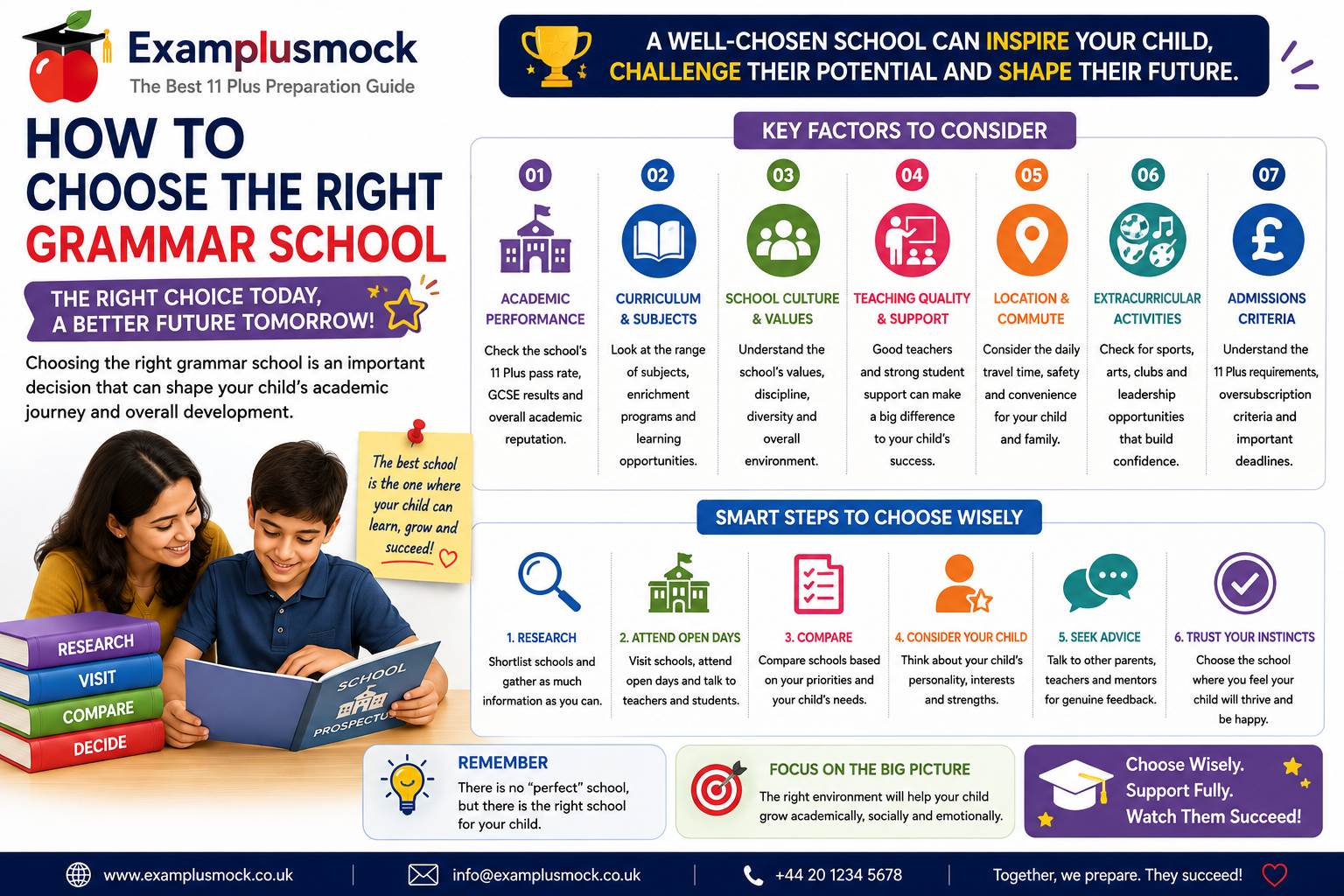
How to Choose the Right Grammar School
Choosing a secondary school is one of the biggest decisions parents make during the 11+ journey. For families considering selective education, this Grammar School Guide explains why the choice involves much more than finding a school with strong examination results. Parents need to think about the school’s academic approach, admissions criteria, location, travel arrangements, pastoral care, extracurricular opportunities, and whether the environment is suitable for their child.
A good Grammar School Guide should therefore help families compare schools carefully rather than simply choosing the most popular option. Every child is different, and a school that works exceptionally well for one student may not necessarily be the best choice for another. Grammar schools can offer a challenging academic environment, but parents should look beyond league tables and reputation. Visiting schools, reading admission policies, understanding catchment arrangements, and discussing the options with your child can provide a much clearer picture. The right school should support your child’s academic development while also allowing them to feel confident, motivated, and comfortable.
Start by Understanding What Your Child Needs
Before comparing grammar schools, think about your child’s individual needs. A good Grammar School Guide should consider more than academic ability, as this is only one part of making the right decision.
Consider whether your child:
- Enjoys academic challenges.
- Works well independently.
- Responds positively to competition.
- Enjoys reading and problem-solving.
- Is comfortable with structured learning.
- Benefits from encouragement and support.
- Has particular academic interests.
- Enjoys sports, music, drama, technology, or other activities.
Some children thrive in highly academic environments where they are constantly challenged. Others may perform better in a school with a broader approach and less competitive pressure. This is why a useful Grammar School Guide should begin with the child rather than the school’s reputation.
Research Grammar Schools in Your Area
Once you understand what your child needs, research the grammar schools available in your area as part of your Grammar School Guide.
Start by creating a simple shortlist containing:
- School name.
- Location.
- Admission authority.
- Entrance examination provider.
- Subjects tested.
- Registration deadline.
- Open-day dates.
- Catchment or priority areas.
- Number of places.
- Previous admission information.
Do not assume that every grammar school follows the same process. Admission arrangements can differ significantly between schools and local authorities. As part of your Grammar School Guide, official school websites and local authority admissions information should always be checked before making important decisions. A shortlist makes the process easier because you can compare schools using the same criteria rather than relying on general impressions.
Check the Grammar School Admissions Policy
Parents should always check the latest official admissions information before applying. The GOV.UK school admissions guidance explains how families can research schools, admission criteria, Ofsted reports, and school performance information. This is an important step in any Grammar School Guide because admission rules can vary between schools.
Look carefully for information about:
- Qualifying scores.
- Standardization.
- Ranking.
- Catchment areas.
- Distance criteria.
- Sibling priority.
- Special priority categories.
- Waiting lists.
- Appeals.
- Registration deadlines.
Some schools may rank children according to examination performance, while others may use additional oversubscription criteria. Parents should never choose a school based solely on an assumed pass mark. Understanding the complete admission process is a central part of any Grammar School Guide.
Compare the School’s Academic Approach
Academic performance is naturally important when selecting a grammar school, but examination results should not be the only factor. Look at how the school supports students academically and consider this as an important part of your Grammar School Guide.
Questions worth asking include:
- Does the school offer a broad curriculum?
- How does it support high-achieving pupils?
- Are students encouraged to think independently?
- What additional academic programmes are available?
- Does the school provide enrichment activities?
- How does it support pupils who struggle with particular subjects?
A school with excellent results may not necessarily provide the learning environment your child needs. Try to understand how students are taught rather than focusing only on statistics.
Consider the 11+ Examination Requirements
Different grammar schools can use different examination systems, so parents should confirm the exact requirements before beginning preparation. As part of your Grammar School Guide, understanding the specific test format, subjects, and assessment criteria can help families prepare more effectively.
Depending on the school, children may be assessed in areas such as the following:
- English.
- Mathematics.
- Verbal Reasoning.
- Non-Verbal Reasoning.
- Creative Writing.
The format, timing, question types, and scoring system can also vary. Knowing these details early allows you to choose appropriate preparation materials and avoid spending months practicing skills that may not be assessed. If your child is preparing for the 11+, realistic practice can help them become comfortable with timed questions and different exam formats. You can explore 11+ preparation resources and mock exams at https://examplusmock.co.uk/ and https://examplusmock.co.uk/11-plus-mock-tests/.
Visit Schools Before Making Your Choice
Online research is useful, but visiting a school can provide information that statistics cannot. As part of your Grammar School Guide, open days and school tours give parents and children an opportunity to experience the school’s atmosphere first-hand.
During a visit, pay attention to:
- How staff interact with students.
- Whether pupils appear engaged.
- Classroom environments.
- School facilities.
- Libraries and study areas.
- Sports facilities.
- Music and drama spaces.
- Technology resources.
- General cleanliness and organization.
Your child should also have an opportunity to express their own opinion. Ask them what they liked and disliked after the visit. Their response may reveal important preferences that parents might otherwise overlook.
Think Carefully About Travel Time
Travel is often underestimated when families compare grammar schools. A good Grammar School Guide should consider the daily journey carefully, as a school may have an excellent reputation, but a very long commute could affect your child’s energy, sleep, homework routine, and participation in extracurricular activities.
Consider:
- Walking distance.
- Bus routes.
- Train connections.
- Travel time during peak hours.
- Transport costs.
- Reliability of public transport.
- Whether your child can travel independently.
- How the journey may change during winter months.
Try the journey at the time your child would actually travel to school. A short journey can make everyday school life considerably easier, particularly when children have homework, clubs, sports, or other activities after school.
Compare Pastoral Care and Student Well-being
Grammar schools are academically demanding, so strong pastoral support is particularly important. As part of your Grammar School Guide, parents should investigate how the school supports students emotionally and socially, including the availability of pastoral staff, wellbeing programmes, and support when students face challenges.
Look for information about:
- Form tutors.
- Pastoral teams.
- Counselling services.
- Anti-bullying policies.
- Mental health support.
- Transition programs.
- Peer mentoring.
- Student wellbeing initiatives.
Ask how the school responds when a student becomes overwhelmed or struggles academically. Children need to feel that they can ask for help without embarrassment. A strong Grammar School Guide should always consider wellbeing alongside academic performance.
Look at Extracurricular Opportunities
School life should not be entirely focused on examinations. A good Grammar School Guide should also consider extracurricular activities, as they can help children discover interests, build friendships, develop confidence, and learn valuable teamwork skills.
Check whether the school offers opportunities in areas such as the following:
- Football.
- Athletics.
- Swimming.
- Tennis.
- Music.
- Choir.
- Orchestra.
- Drama.
- Art.
- Coding.
- Science clubs.
- Debate.
- Public speaking.
- Chess.
- Languages.
Think about what your child already enjoys and whether the school offers opportunities to continue developing those interests. You should also look at how accessible these activities are and whether participation is encouraged across the student body.
Examine School Facilities
Facilities can influence how children experience school each day. As part of your Grammar School Guide, consider the quality and suitability of classrooms, libraries, science laboratories, sports facilities, technology resources, and other learning spaces.
When visiting a school, consider whether it provides appropriate resources for:
- Science.
- Mathematics.
- Computing.
- Languages.
- Art.
- Music.
- Physical education.
- Reading.
- Independent study.
A modern building is not automatically better, but good facilities can enhance learning when they are well maintained and effectively used. Ask whether students have access to specialist facilities and whether these are regularly used as part of lessons and enrichment activities.
Read Reviews Carefully
Parent reviews can provide useful insights into school life, but they should not be treated as the final authority. Online reviews are personal experiences and may reflect individual circumstances. Instead of relying on one positive or negative comment, look for recurring themes. Parents can also check the school’s latest inspection information through Ofsted’s official inspection report search. Reading an official report alongside parent opinions can provide a more balanced Grammar School Guide and help families understand areas such as leadership, teaching, behaviour, and the overall school environment.
You can compare information from:
- Parent reviews.
- School publications.
- Inspection reports.
- Official school websites.
- Local authority information.
- Open-day experiences.
- Conversations with current parents.
Try to separate factual information from personal opinions. A balanced research process will give you a much more reliable picture of the school.
Compare Academic Results Responsibly
Academic results can help parents understand how a school performs, but they should always be viewed in context. A reliable Grammar School Guide should encourage parents to consider results alongside teaching quality, student progress, pastoral support, and the overall learning environment.
Consider:
- GCSE results.
- A-level results where applicable.
- Progress measures.
- Subject performance.
- University destinations.
- Breadth of curriculum.
- Student support.
Avoid assuming that one year’s results tell you everything about a school. Results can change over time, and they do not necessarily show whether your child will feel happy and supported there. The best Grammar School Guide approach is to combine academic data with information about the school’s culture, teaching, wellbeing, and opportunities.
Speak to Other Parents
Current parents can sometimes provide useful insights into everyday experiences that are difficult to find online. As part of your Grammar School Guide, speaking with current parents can help you understand the school’s communication, teaching approach, pastoral support, extracurricular activities, and overall day-to-day environment.
If you know families with children at the schools you are considering, ask about the following:
- Homework levels.
- Communication with parents.
- School transport.
- Extracurricular activities.
- Teacher support.
- Exam pressure.
- Parent meetings.
- School clubs.
- General workload.
Avoid treating one person’s experience as universal. Instead, use conversations with other parents to identify questions that you should investigate further yourself.
Involve Your Child in the Decision
Parents naturally have the final responsibility for choosing a secondary school, but children should still be involved in the process. A thoughtful Grammar School Guide should encourage families to discuss school options together and consider the child’s opinions, interests, concerns, and feelings about each school.
Ask your child:
- Which school did you like most?
- Which environment felt comfortable?
- What activities interested you?
- Did you like the classrooms?
- How did you feel around the students?
- How would you feel travelling there every day?
A child who feels involved in the decision may be more motivated to prepare for the 11+ examination and transition confidently into secondary school. Choosing the right school should be a family decision based on evidence, practical considerations, and the child’s individual needs.
Compare Grammar Schools Using a Simple Checklist
When several schools appear suitable, comparing them side by side can make the decision much easier. As part of your Grammar School Guide, create a checklist and give each school a score for the factors that matter most to your family. This makes it easier to compare options objectively instead of relying on memory or general impressions.
Consider rating each school for:
| Factor | What to Consider |
|---|---|
| Academic performance | Results, curriculum and academic support |
| Admissions | Exam, qualifying score and oversubscription criteria |
| Location | Distance and daily travel time |
| Pastoral care | Well-being and student support |
| Activities | Sports, music, clubs and enrichment |
| Facilities | Classrooms, laboratories, the library, and sports areas |
| School culture | Atmosphere, expectations and student behaviour |
| Child’s preference | How comfortable your child feels there |
This simple approach can prevent one impressive feature from overshadowing other important considerations.
Understand Catchment and Distance Rules
Location can be extremely important when applying to selective schools. A good Grammar School Guide should explain that some grammar schools have catchment areas, while others may use distance from the school as an oversubscription criterion. Parents should check each school’s current admissions policy carefully before applying.
Parents should check the school’s current admission policy for details about:
- Catchment boundaries.
- Priority areas.
- Distance measurements.
- Sibling priority.
- Feeder schools.
- Exceptional circumstances.
- How distance is calculated.
Do not assume that passing the entrance examination guarantees a place. A child may achieve the required academic standard but still face competition for available places. This is why a reliable Grammar School Guide should always include admissions research alongside academic preparation.
Check Registration and Application Deadlines
Grammar school applications can involve several separate deadlines. As part of your Grammar School Guide, parents should keep track of key dates for registration, entrance tests, school applications, appeals, and any required supporting documents to avoid missing important deadlines.
Parents may need to complete the following:
- Entrance examination registration.
- The grammar school’s application process.
- Local authority secondary school application.
- Supporting documentation where required.
- Appeals or waiting-list procedures if necessary.
Write all important dates on a calendar and set reminders well in advance. Missing a registration deadline can create significant problems, even when a child is academically prepared. Always confirm dates directly with the relevant school or admissions authority because deadlines and procedures can change.
Look at the School’s Communication With Parents
Parents should consider how effectively a school communicates with families. A good Grammar School Guide should encourage parents to look at how the school shares updates, responds to questions, provides academic information, and keeps families informed about important events and decisions.
During your research, look for evidence of:
- Clear newsletters.
- Parent information evenings.
- Online portals.
- Regular progress updates.
- Accessible staff.
- Homework information.
- Event calendars.
- Emergency communication procedures.
Strong communication can make the transition from primary to secondary school much smoother. Parents should feel confident that they know where to find information and whom to contact if a concern arises.
Consider Homework and Academic Pressure
Grammar schools are academically selective, so children should expect to be challenged. However, a good Grammar School Guide should encourage parents to consider whether the level of homework and academic pressure is appropriate for their child, while also allowing enough time for rest, hobbies, family life, and other activities.
Ask during an open day or school visit:
- How much homework do students typically receive?
- How are assignments monitored?
- What support is available when work becomes difficult?
- How does the school encourage independent study?
- Are students encouraged to maintain hobbies?
The goal is not necessarily to find the school with the least homework. Instead, look for an environment where academic expectations are high but students are given appropriate support to meet them.
Consider Sixth Form and Future Opportunities
Although your child is applying for Year 7, it is useful to consider what the school offers later in their education. A good Grammar School Guide should encourage parents to look at GCSE and sixth-form options, subject choices, careers support, and opportunities for further education.
Look at:
- GCSE subject choices.
- Sixth-form provision.
- A-level or equivalent courses.
- Careers guidance.
- University preparation.
- Work experience.
- Leadership opportunities.
- Academic enrichment.
A school that offers strong long-term opportunities can provide continuity throughout secondary education. However, parents should still focus on the child’s immediate needs rather than choosing a school solely because of its sixth-form reputation.
Understand What Makes a School a Good Fit
A highly regarded grammar school may be excellent academically, but that does not automatically mean it is the best choice for every child. A thoughtful Grammar School Guide should encourage parents to consider their child’s individual needs, personality, learning style, interests, wellbeing, and the overall suitability of the school environment.
A good school fit may depend on:
- Teaching style.
- School culture.
- Academic expectations.
- Child’s confidence.
- Travel arrangements.
- Friendships.
- Extracurricular interests.
- Pastoral support.
Imagine your child attending the school every day. Would they feel comfortable asking questions? Would they enjoy the activities? Would the journey be manageable? Would they feel appropriately challenged? These questions can be more useful than simply asking which school has the highest ranking.
Prepare Your Child for the Transition
Once you have identified a preferred grammar school, help your child become familiar with what secondary school will involve. As part of your Grammar School Guide, talk to your child about lessons, homework, new routines, friendships, and the expectations they may encounter when starting secondary school.
Discuss:
- New subjects.
- Different teachers.
- Homework expectations.
- Traveling independently.
- Making new friends.
- Joining clubs.
- Managing a timetable.
- Organizing school equipment.
If the school provides transition events, encourage your child to attend. The more familiar the new environment feels, the easier it may be for your child to approach the transition with confidence.
Use Mock Tests to Prepare for the Entrance Exam
Choosing the right school is only one part of the 11+ journey. A complete Grammar School Guide should also recognise that children need to prepare for the entrance examination used by their preferred schools, with enough time to understand the test format, practise key skills, and build confidence.
Mock tests can help children become familiar with the following:
- Timed questions.
- Exam instructions.
- Different question types.
- Answering under pressure.
- Managing difficult questions.
- Checking answers.
Parents should use mock results diagnostically rather than treating them as predictions of the final result. If your child consistently struggles with a particular area, use that information to guide future revision. For additional practice, parents can explore https://examplusmock.co.uk/11-plus-mock-tests/.
Avoid Choosing a School Solely for Its Ranking
League tables and examination results can be useful, but they should never be the only deciding factor. A balanced Grammar School Guide should encourage parents to consider academic performance alongside teaching quality, pastoral care, school culture, facilities, location, and whether the school meets their child’s individual needs.
A school with slightly lower results may provide the following:
- Better pastoral support.
- A shorter commute.
- Stronger extracurricular opportunities.
- Better facilities for your child’s interests.
- A more suitable learning environment.
Likewise, the highest-performing school may not necessarily be the right fit for your child. The strongest Grammar School Guide approach is to consider the entire educational experience rather than a single statistic.
Think About Your Child’s Long-Term Happiness
A child may achieve excellent academic results but still struggle if they are unhappy, exhausted, or constantly anxious. A thoughtful Grammar School Guide should therefore encourage parents to consider their child’s wellbeing, happiness, confidence, and ability to manage the school’s academic demands alongside their educational progress.
Parents should therefore think about:
- Confidence.
- Friendships.
- Emotional wellbeing.
- Sleep.
- Exercise.
- Hobbies.
- Family time.
- Academic motivation.
A successful secondary school experience should help children grow academically and personally. The best school is one where your child can be challenged while still feeling supported.
What If Your Child Does Not Get Their First Choice?
Parents should prepare for different outcomes rather than assuming that one particular school will definitely be offered. A practical Grammar School Guide should encourage families to create a list of realistic alternatives and understand the admission process, deadlines, and requirements for each school.
Your backup plan might include:
- Another grammar school.
- A comprehensive school.
- An academy.
- An independent school.
- Another suitable local secondary school.
Having alternatives does not mean expecting failure. It simply ensures that the family is prepared for different admission outcomes.
Frequently Asked Questions
How do I choose the best grammar school for my child?
The best grammar school depends on your child’s individual needs rather than simply its academic reputation. Parents should compare examination requirements, admission rules, location, travel time, academic performance, pastoral care, facilities, extracurricular activities, and school culture. Visiting schools and involving your child in the process can also reveal important differences. A useful Grammar School Guide should help families consider the complete school experience and identify an environment where their child can feel supported, challenged, and motivated.
What should I look for when visiting a grammar school?
During a school visit, look beyond the appearance of the buildings. As part of your Grammar School Guide, observe how students interact with teachers, whether classrooms feel engaging, and whether pupils appear confident and comfortable. Ask about homework, pastoral care, extracurricular activities, academic support, and communication with parents. Check specialist facilities such as laboratories, libraries, sports areas, music rooms, and technology spaces. Most importantly, ask your child how they felt about the school after the visit.
Does a child have to live near a grammar school?
Not always. Admission arrangements vary between grammar schools. A reliable Grammar School Guide should explain that some may have catchment areas or distance-based criteria, while others may accept applications from a wider geographical area. Parents should carefully read the current admission policy of each school before applying. Travel time should also be considered even where distance does not affect admission. A school that requires a very long daily journey may not be practical for every child, so location remains an important part of choosing the right school.
Is a grammar school always better than a comprehensive school?
Not necessarily. Grammar schools can provide a highly academic environment that suits children who enjoy challenging studies, but comprehensive schools can also offer excellent teaching, extracurricular opportunities, pastoral care, and academic progression. A good Grammar School Guide should emphasise that the right choice depends on the child’s needs, personality, interests, and educational goals. Parents should compare schools individually rather than assuming that one type of school is automatically better. A good educational environment is one where a child can develop academically and personally.
How can my child prepare for a grammar school entrance exam?
Preparation should begin with understanding the specific examination used by the chosen school. Children may need to practise English, Mathematics, Verbal Reasoning, Non-Verbal Reasoning, or other assessed skills. Daily reading, vocabulary development, topic revision, timed exercises, and mock exams can help build confidence. Parents should review mistakes carefully and use practice results to identify areas requiring additional attention. More preparation resources and realistic mock tests can be found at https://examplusmock.co.uk/.
Conclusion
Choosing the right grammar school is about much more than finding the school with the highest examination results. Parents should consider the complete educational experience and ask whether the school is genuinely suitable for their child’s academic, emotional, social, and practical needs. A strong Grammar School Guide should encourage families to research admission policies carefully, compare schools objectively, attend open days, consider travel arrangements, and listen to their child’s opinions.
The 11+ examination is also an important part of the process. Understanding the school’s entrance requirements early allows parents to prepare their child using appropriate resources and realistic practice. Mock exams, reading, vocabulary development, Mathematics revision, and reasoning exercises can all help children approach the assessment with greater confidence. Ultimately, the right grammar school is not necessarily the most famous or highest-ranked school. It is the school where your child can learn, grow, make friends, explore their interests, and feel supported while being appropriately challenged. Taking time to research your options carefully can help your family make a confident and informed decision about secondary education.